


[ad_1]

This blog was co-written by Anant Shah, Sr. Product Manager, Cisco Data Center Networking.
As organizations race to support hybrid clouds, multi-cloud environments, and the explosive demands of AI-driven workloads, the complexity of managing data center networks has reached a tipping point. NetOps and SecOps teams are often drowning in data but starving for insights. The challenge isn’t just about collecting telemetry; it’s about making that data actionable, immediate, and secure.
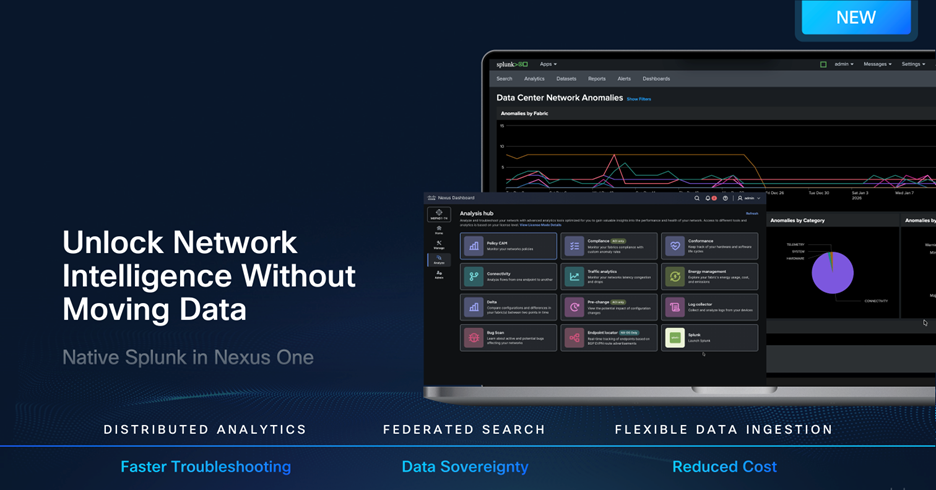
To bridge this gap, we are thrilled to announce a significant leap forward in network observability: Native Splunk in Cisco Nexus One.
This isn’t just another connector or API call. This is an embedded, architectural integration designed to transform how you monitor, troubleshoot, and secure your data center fabric. By bringing the power of Splunk directly into the Data Center Networking environment, we are enabling teams to solve complex problems faster, maintain strict data sovereignty, and dramatically reduce operational costs.
Cisco Nexus One delivers a unified management plane for fabrics with on-premises managed Cisco Nexus Dashboard and cloud-managed Nexus Hyperfabric. It provides advanced intelligence, observability, security, breakthrough silicon and systems for seamless and secure AI workload deployment.
The Observability Gap in Modern Fabrics
Traditionally, network monitoring involves a trade-off. You either send massive amounts of raw logs to a centralized data lake, incurring high ingress and storage costs. Or you rely on sampled data that misses critical microbursts and anomalies.
Furthermore, the “swivel-chair” effect hampers operations. Engineers jump between network controllers and various event management tools, trying to manually correlate a configuration change made at for example at 2:00 PM with a performance jitter that started at 2:05 PM. In the age of AI workloads where millisecond latency matters, this manual correlation is no longer sustainable.
Introducing Native Splunk in Nexus One
The Native Splunk integration changes the paradigm by running Splunk capabilities directly within the Cisco Nexus Dashboard. This allows for the streaming of high-fidelity telemetry, including anomalies, advisories, and audit logs, directly to Splunk analytics.
By processing data at the source, you gain immediate visibility without the latency or cost of shipping every byte to the cloud or a central platform. It represents a convergence of Cisco’s industry-leading data center networking with Splunk’s powerful data analytics platform.
Transforming Operations: Key Customer Outcomes
We designed this integration to drive specific, high-value outcomes for engineering teams. Here is how Native Splunk in Nexus Dashboard impacts your daily operations.
1. Accelerated Root Cause Analysis (RCA)
Mean Time to Resolution (MTTR) is the metric that keeps IT leaders awake at night. The Native Splunk integration drastically reduces MTTR by correlating disparate data points in real-time.
Imagine a scenario where an application suffers performance degradation. With this integration, you can instantly correlate configuration changes (audit logs) with network anomalies (telemetry) on a single dashboard. You can see that a specific policy change applied to a leaf switch coincides exactly with a spike in dropped packets. What used to take hours of cross-team meetings can now be identified in minutes.
2. Data Sovereignty and Compliance
For organizations in regulated industries such as finance, healthcare, government, data residency is non-negotiable. Sending sensitive network logs to a public cloud instance for analysis can violate strict compliance frameworks.
Native Splunk in Nexus Dashboard addresses this by keeping sensitive data on-premises and within the local jurisdiction of data. You get the benefit of advanced Splunk analytics without the data ever leaving your physical data center. This ensures you meet regulatory requirements regarding data gravity and sovereignty while still leveraging modern observability tools.
3. Operational Cost Efficiency
The cost of cloud observability is rising. “Egress shock” happens when organizations realize the price tag attached to moving terabytes of high-fidelity network data into the cloud for analysis.
By performing embedded analytics locally on the Nexus Dashboard, you filter the noise from the signal. You analyze high-fidelity telemetry locally and only export high-level insights or specific alerts if needed. This architecture significantly reduces cloud storage fees and data transfer costs, optimizing your operational budget without sacrificing visibility.
4. Federated Visibility
Silos are the enemy of uptime. This integration provides federated visibility, meaning you can create unified dashboards that deliver cross-domain insights regardless of where the data originated. Whether you are running Cisco ACI, NX-OS, or a mix of both, the Native Splunk integration normalizes this data into a coherent operational view.
A Unified View for NetOps and SecOps
Perhaps the most profound impact of this integration is cultural. It forces a convergence between Network Operations (NetOps) and Security Operations (SecOps).
Security teams need network data to identify threats, while network teams need security context to manage traffic. By using Splunk as the common language on top of Cisco Nexus infrastructure, both teams view the same reality. An “anomaly” in traffic flow is investigated simultaneously as a potential configuration error by NetOps and a potential exfiltration attempt by SecOps.
Conclusion
The data center is the heart of the digital enterprise, and its heartbeat is the network. With the integration of Native Splunk on Cisco Nexus One and Nexus Dashboard, we are giving you the stethoscope needed to listen to that heartbeat with unprecedented clarity.
This solution delivers on the promise of full-stack observability: high-fidelity data, processed locally for speed and security, providing actionable insights that drive business resilience.
Ready to transform your data center operations?
We’d love to hear what you think. Ask a Question, Comment Below, and Stay Connected with #CiscoPartners on social!
Cisco Partners Facebook | @CiscoPartners X/Twitter | Cisco Partners LinkedIn
[ad_2]
Source link
