


[ad_1]
AI is reshaping how we process data, solve complex problems, and deliver digital experiences. But your AI environment is only as secure as the infrastructure it runs on—and attackers know exactly where to look for weaknesses.
As you scale AI workloads closer to end users, agents, and machines, a critical challenge emerges: you must maximize GPU and CPU utilization while also defending against sophisticated, fast-moving threats.
Traditional security models struggle in these environments. Centralized firewall appliances can become traffic choke points that don’t scale to AI-level throughput. Host-based software agents can also tax CPU resources you need for AI processing—and, in some cases, introduce operational risk in multi-tenant environments.
To address this, Cisco and NVIDIA are partnering to redefine AI security. By extending Cisco Hybrid Mesh Firewall to NVIDIA BlueField data processing units (DPUs), Cisco brings stateful segmentation directly into AI servers connected to Cisco Nexus One AI front-end fabrics. The result is a robust, hardware-accelerated, server-level security architecture that helps stop threats before they reach your data—maximizing protection with no performance tradeoff.
With Cisco Hybrid Mesh Firewall, you can define policy once and enforce it everywhere. This unified security model spans physical and virtual firewalls, cloud environments, and now the DPUs inside your AI servers.
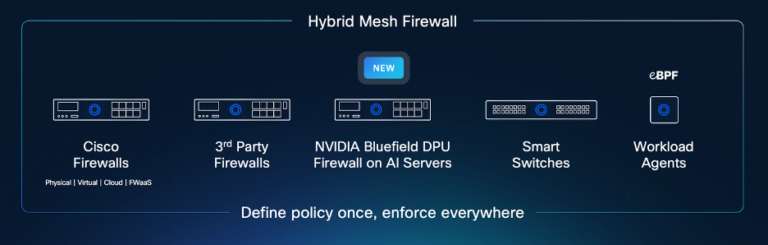
The front-end network: The real security domain
In AI infrastructure, the most important security boundary is the front-end network, where users submit inference and training requests, storage systems exchange datasets and checkpoints, and multi-tenant workloads often share the same servers. Because external traffic enters here, it’s the zone where inspection and isolation matter most.
Front-end traffic typically falls into two primary flows:
- User → Compute (inference and training)
- Compute ↔ Storage (data ingest, dataset access, checkpointing)
In AI environments, you can’t assume only “some” traffic needs inspection. Nearly all of it does, and multi-tenancy demands strict segmentation. That requires segmentation that can operate at full line rate across the front-end fabric.
Traditional centralized firewall appliances break this model. Hair-pinning traffic to an external firewall increases latency and creates bandwidth bottlenecks, effectively a choke point for the entire cluster.
Bringing security to the AI workload with DPUs
A better model is server-level enforcement using DPUs. By running the firewall on an NVIDIA BlueField DPU—not the host CPU—you reduce the risk of tenant tampering and preserve CPU/GPU cycles for AI workloads.
Cisco is redefining AI workload protection by enforcing unified security policy using Hybrid Mesh Firewall on AI servers with NVIDIA BlueField DPUs. This enables:
- Air-gapped enforcement in multi-tenant and bare-metal environments
- Hardware-accelerated 400G line-rate stateful segmentation in DPU
- VPC-aware policy enforcement at the network edge
- Fine-grained observability per flow in hardware at scale
- Lateral movement containment, helping block east–west attacks at the server boundary
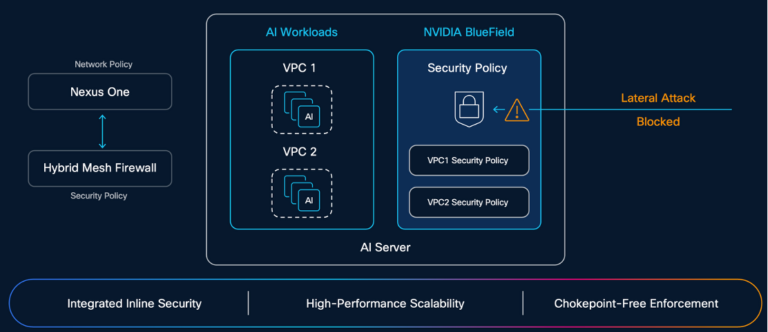
Cisco Nexus One simplifies how network policy is built, deployed, and kept aligned with workload identity and context.
On each AI server, it discovers Kubernetes workload metadata and shares that context with Cisco Hybrid Mesh Firewall, which translates it into application-aware, stateful segmentation rules:
- Local discovery (Nexus One): A unified management plane runs on each AI server to collect Kubernetes inventory metadata—workload/application identity, labels and annotations, namespaces, etc.
- Context-aware policy (Hybrid Mesh Firewall): Uses the above metadata to generate application-aware, stateful segmentation policies for each workload.
- DPU enforcement: Policies are enforced inline on the NVIDIA BlueField DPU without external agents or software.
- Kubernetes integrations: Optimized for the Isovalent Kubernetes suite (including Cilium CNI and Hubble) and compatible with standard Kubernetes environments.
“AI is transforming every industry, and the rapid rise of AI factories is driving a growing need for cybersecurity at scale across enterprise infrastructure. By embedding Cisco’s Hybrid Mesh Firewall policy into NVIDIA BlueField DPUs on AI servers, our joint customers achieve high-performance, multi-tenant, intent-driven enforcement and hardware-accelerated protection, seamlessly connected via Cisco Nexus One AI front-end fabrics.”
—Kevin Deierling, SVP of Networking, NVIDIA
Cisco Nexus One: Network policy orchestration and visibility for AI front-end fabrics
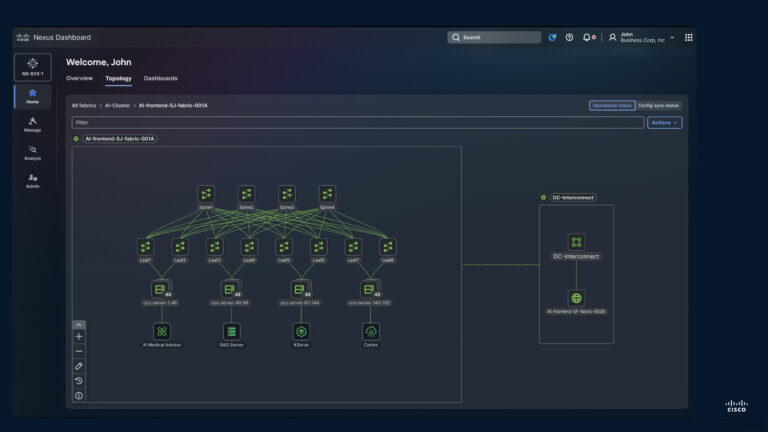
Cisco Nexus One takes these capabilities further by orchestrating complex network policies and maintaining end-to-end visibility with multisite implementations in AI front-end fabrics (as shown below). This simplifies operations, strengthens compliance enforcement, and provides a security framework that scales as AI environments grow.
Building the secure AI factory of the future
AI factories succeed when security keeps pace with AI-scale throughput. By running Cisco Hybrid Mesh Firewall on NVIDIA BlueField DPUs, we provide distributed, in-server enforcement with 400G line-rate stateful inspection and fine-grained, flow-level observability—without consuming CPU and GPU resources.
Paired with Cisco Nexus One for centralized network policy and visibility, organizations can scale multi-tenant AI infrastructure with confidence, secure from the inside out.
Security is the first service delivered on the DPU. Next, we’ll expand by adding more AI-centric network services running on DPUs.
Roadmap highlights
- Controlled Availability: Q3 CY26
- General Availability: Q4 CY26
What’s new
- Cisco Nexus One: Network policy and visibility
- Hybrid Mesh Firewall: Stateful segmentation on BlueField DPUs
- Splunk: Security observability integration
To try the solution during Controlled Availability in early Q3 CY26, please contact your Cisco account representative.
[ad_2]
Source link
