
Close Menu
  • Home
  • AI
  • Big Data
  • Cloud Computing
  • iOS Development
  • IoT
  • IT/ Cybersecurity
  • Tech
    • Nanotechnology
    • Green Technology
    • Apple
    • Software Development
    • Software Engineering

Subscribe to Updates

Get the latest technology news from Bigteetechhub about IT, Cybersecurity and Big Data.

    What's Hot

    Cisco Solutions for AI and Bandwidth Challenges

    April 4, 2026

    New Apple TV Waiting for Siri: Here’s What’s Coming When It Launches

    April 4, 2026

    GitOps Implementation at Enterprise Scale, Moving Beyond Traditional CI/CD

    April 4, 2026
    Facebook X (Twitter) Instagram
    Facebook X (Twitter) Instagram
    Big Tee Tech Hub
    • Home
    • AI
    • Big Data
    • Cloud Computing
    • iOS Development
    • IoT
    • IT/ Cybersecurity
    • Tech
      • Nanotechnology
      • Green Technology
      • Apple
      • Software Development
      • Software Engineering
    Big Tee Tech Hub
    Home»Cloud Computing»Cisco Solutions for AI and Bandwidth Challenges
    Cloud Computing

    Cisco Solutions for AI and Bandwidth Challenges

    big tee tech hubBy big tee tech hubApril 4, 2026003 Mins Read
    Share Facebook Twitter Pinterest Copy Link LinkedIn Tumblr Email Telegram WhatsApp
    Follow Us
    Google News Flipboard
    Cisco Solutions for AI and Bandwidth Challenges
    Share
    Facebook Twitter LinkedIn Pinterest Email Copy Link


    AI adoption is accelerating, and it comes with a surge in bandwidth demand, low-latency requirements, and operational complexity. For broadband service providers, the pressure is increasing as video analytics, generative AI (GenAI) agents, immersive applications, and enterprise automation reshape network traffic patterns. 

    The Cisco Agile Services Networking and Cisco Unified Edge platforms were built to help providers meet these challenges. They create scalable, service-centric, AI-ready foundations that help reduce network strain, enable differentiated services, and support sustainable revenue growth. AI adoption is accelerating, and it comes with a surge in bandwidth demand, low-latency requirements, and operational complexity. For broadband service providers, the pressure is increasing as video analytics, generative AI (GenAI) agents, immersive applications, and enterprise automation reshape network traffic patterns. The Cisco Agile Services Networking and Cisco Unified Edge platforms were built to help providers meet these challenges. They create scalable, service-centric, AI-ready foundations that help reduce network strain, enable differentiated services, and support sustainable revenue growth. Figure 1: A sample network architecture with Cisco Routed PON used in the access network—one of the many Agile Services Networking solutions that teams can implement to deliver quality customer experiences while controlling costs Alt Text (included in backend for accessibility, describes image for those with vision impairments): A technical diagram illustrating Cisco Agile Services Networking architecture, showing Routed PON as an access technology that provides connectivity into the edge and core provider networks. Reducing backhaul demand with local AI processing Many AI workloads, especially inferencing, originate at the network edge: cameras, sensors, Wi-Fi devices, enterprise applications, and customer equipment. Traditionally, raw data is transported back to the core or cloud for processing, placing heavy load on transport and backhaul networks. Cisco Unified Edge changes this model by placing compute, storage, and inferencing capabilities directly at the edge, including metro points of presence (POPs), aggregation sites, and enterprise locations. Benefits include: Less raw data flowing through the backbone Reduced peak bandwidth usage Lower congestion in the core network By performing inferences where data is generated, providers can significantly decrease backhaul requirements and improve efficiency. Enabling ultra-low-latency AI experiences Real-time AI applications require extremely low latency. These include video analytics, interactive agents, AR/VR, smart retail automation, and industrial controls. Unified Edge processes inference close to the end user, enabling consistent, low-latency performance without relying on distant cloud regions. This makes broadband networks capable platforms for high-performance, latency-sensitive AI services. Powering intelligent traffic prioritization and service assurance As AI traffic grows, it competes with all other broadband services. Agile Services Networking addresses this challenge through a service-centric architecture designed for policy-based traffic control. Agile Services Networking enables: Prioritization and classification of AI and non-AI traffic Predictable latency, jitter, and performance through QoS and slicing Multidomain service assurance across access, metro, and core Support for differentiated service tiers and business models This helps ensure AI workloads get the performance they need without overrunning the network. Delivering automation at scale for distributed edge sites As more edge locations come online, managing them manually becomes impractical. Cisco provides automation and centralized operations across both Agile Services Networking and Unified Edge, including: Zero-touch provisioning Consistent policy automation Unified lifecycle management Streamlined deployment of AI workloads and updates This enables operators to scale edge compute and AI services without proportional increases in operational cost. Providing real-time observability and AI-driven network optimization AI-driven applications produce dynamic traffic patterns. Agile Services Networking includes deep observability and supports closed-loop automation to adapt the network in real time. Network operators can: Detect congestion and anomalies Adjust traffic classes or slices instantly Shift workloads to available edge sites Expand or contract service capacity automatically This establishes the foundation for autonomous broadband operations. Unlocking new AI-driven revenue opportunities Instead of treating AI as a cost driver, Agile Services Networking and Unified Edge allow providers to turn it into a business opportunity. Possible offerings include: Premium low-latency paths for AI traffic Hosted inference services at the edge Managed edge compute for enterprises Video analytics and automation services Assured connectivity tiers for AI-intensive customers This creates sustainable service models that align with growing enterprise AI demand. Securing distributed, data-sensitive AI workloads Unified Edge enables sensitive or regulated data to be processed locally, reducing exposure and meeting compliance requirements. Agile Services Networking extends this by providing secure, policy-driven transport and isolation across the entire network. This combination offers end-to-end security for distributed AI applications. Empowering broadband providers to thrive today—and tomorrow AI transforms applications, workflows, and customer expectations. Traffic is growing, latency requirements are tightening, and enterprises are seeking real-time experiences delivered at scale. Cisco Agile Services Networking provides the automated, service-aware, assured transport foundation needed to meet these new demands. Cisco Unified Edge delivers AI compute and inference capabilities close to subscribers. Together, they help broadband providers reduce network strain, deliver advanced AI-powered services, and unlock new revenue models while preparing for the next decade of AI-driven growth. AI adoption is accelerating, and it comes with a surge in bandwidth demand, low-latency requirements, and operational complexity. For broadband service providers, the pressure is increasing as video analytics, generative AI (GenAI) agents, immersive applications, and enterprise automation reshape network traffic patterns. The Cisco Agile Services Networking and Cisco Unified Edge platforms were built to help providers meet these challenges. They create scalable, service-centric, AI-ready foundations that help reduce network strain, enable differentiated services, and support sustainable revenue growth. Figure 1: A sample network architecture with Cisco Routed PON used in the access network—one of the many Agile Services Networking solutions that teams can implement to deliver quality customer experiences while controlling costs Alt Text (included in backend for accessibility, describes image for those with vision impairments): A technical diagram illustrating Cisco Agile Services Networking architecture, showing Routed PON as an access technology that provides connectivity into the edge and core provider networks. Reducing backhaul demand with local AI processing Many AI workloads, especially inferencing, originate at the network edge: cameras, sensors, Wi-Fi devices, enterprise applications, and customer equipment. Traditionally, raw data is transported back to the core or cloud for processing, placing heavy load on transport and backhaul networks. Cisco Unified Edge changes this model by placing compute, storage, and inferencing capabilities directly at the edge, including metro points of presence (POPs), aggregation sites, and enterprise locations. Benefits include: Less raw data flowing through the backbone Reduced peak bandwidth usage Lower congestion in the core network By performing inferences where data is generated, providers can significantly decrease backhaul requirements and improve efficiency. Enabling ultra-low-latency AI experiences Real-time AI applications require extremely low latency. These include video analytics, interactive agents, AR/VR, smart retail automation, and industrial controls. Unified Edge processes inference close to the end user, enabling consistent, low-latency performance without relying on distant cloud regions. This makes broadband networks capable platforms for high-performance, latency-sensitive AI services. Powering intelligent traffic prioritization and service assurance As AI traffic grows, it competes with all other broadband services. Agile Services Networking addresses this challenge through a service-centric architecture designed for policy-based traffic control. Agile Services Networking enables: Prioritization and classification of AI and non-AI traffic Predictable latency, jitter, and performance through QoS and slicing Multidomain service assurance across access, metro, and core Support for differentiated service tiers and business models This helps ensure AI workloads get the performance they need without overrunning the network. Delivering automation at scale for distributed edge sites As more edge locations come online, managing them manually becomes impractical. Cisco provides automation and centralized operations across both Agile Services Networking and Unified Edge, including: Zero-touch provisioning Consistent policy automation Unified lifecycle management Streamlined deployment of AI workloads and updates This enables operators to scale edge compute and AI services without proportional increases in operational cost. Providing real-time observability and AI-driven network optimization AI-driven applications produce dynamic traffic patterns. Agile Services Networking includes deep observability and supports closed-loop automation to adapt the network in real time. Network operators can: Detect congestion and anomalies Adjust traffic classes or slices instantly Shift workloads to available edge sites Expand or contract service capacity automatically This establishes the foundation for autonomous broadband operations. Unlocking new AI-driven revenue opportunities Instead of treating AI as a cost driver, Agile Services Networking and Unified Edge allow providers to turn it into a business opportunity. Possible offerings include: Premium low-latency paths for AI traffic Hosted inference services at the edge Managed edge compute for enterprises Video analytics and automation services Assured connectivity tiers for AI-intensive customers This creates sustainable service models that align with growing enterprise AI demand. Securing distributed, data-sensitive AI workloads Unified Edge enables sensitive or regulated data to be processed locally, reducing exposure and meeting compliance requirements. Agile Services Networking extends this by providing secure, policy-driven transport and isolation across the entire network. This combination offers end-to-end security for distributed AI applications. Empowering broadband providers to thrive today—and tomorrow AI transforms applications, workflows, and customer expectations. Traffic is growing, latency requirements are tightening, and enterprises are seeking real-time experiences delivered at scale. Cisco Agile Services Networking provides the automated, service-aware, assured transport foundation needed to meet these new demands. Cisco Unified Edge delivers AI compute and inference capabilities close to subscribers. Together, they help broadband providers reduce network strain, deliver advanced AI-powered services, and unlock new revenue models while preparing for the next decade of AI-driven growth.
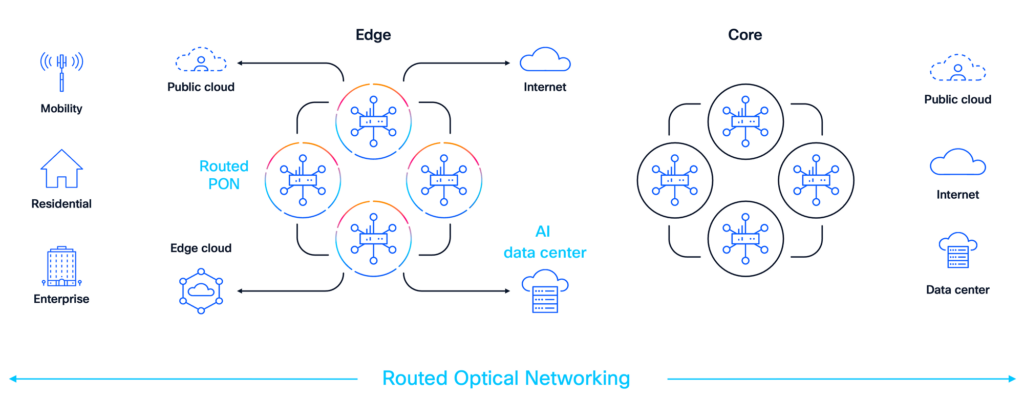
    Figure 1: A sample network architecture with Cisco Routed PON used in the access network—one of the many Agile Services Networking solutions that teams can implement to deliver quality customer experiences while controlling costs 

    Reducing backhaul demand with local AI processing 

    Many AI workloads, especially inferencing, originate at the network edge: cameras, sensors, Wi-Fi devices, enterprise applications, and customer equipment. Traditionally, raw data is transported back to the core or cloud for processing, placing heavy load on transport and backhaul networks. 

    Cisco Unified Edge changes this model by placing compute, storage, and inferencing capabilities directly at the edge, including metro points of presence (POPs), aggregation sites, and enterprise locations. 

    Benefits include: 

    • Less raw data flowing through the backbone 
    • Reduced peak bandwidth usage 
    • Lower congestion in the core network 

    By performing inferences where data is generated, providers can significantly decrease backhaul requirements and improve efficiency. 

    Enabling ultra-low-latency AI experiences 

    Real-time AI applications require extremely low latency. These include video analytics, interactive agents, AR/VR, smart retail automation, and industrial controls.  

    Unified Edge processes inference close to the end user, enabling consistent, low-latency performance without relying on distant cloud regions. This makes broadband networks capable platforms for high-performance, latency-sensitive AI services. 

    Powering intelligent traffic prioritization and service assurance 

    As AI traffic grows, it competes with all other broadband services. Agile Services Networking addresses this challenge through a service-centric architecture designed for policy-based traffic control. 

    Agile Services Networking enables: 

    • Prioritization and classification of AI and non-AI traffic 
    • Predictable latency, jitter, and performance through QoS and slicing 
    • Multidomain service assurance across access, metro, and core 
    • Support for differentiated service tiers and business models 

    This helps ensure AI workloads get the performance they need without overrunning the network. 

    Delivering automation at scale for distributed edge sites 

    As more edge locations come online, managing them manually becomes impractical. Cisco provides automation and centralized operations across both Agile Services Networking and Unified Edge, including: 

    • Zero-touch provisioning 
    • Consistent policy automation 
    • Unified lifecycle management 
    • Streamlined deployment of AI workloads and updates 

    This enables operators to scale edge compute and AI services without proportional increases in operational cost. 

    Providing real-time observability and AI-driven network optimization 

    AI-driven applications produce dynamic traffic patterns. Agile Services Networking includes deep observability and supports closed-loop automation to adapt the network in real time. 

    Network operators can: 

    • Detect congestion and anomalies 
    • Adjust traffic classes or slices instantly 
    • Shift workloads to available edge sites 
    • Expand or contract service capacity automatically 

    This establishes the foundation for autonomous broadband operations. 

    Unlocking new AI-driven revenue opportunities 

    Instead of treating AI as a cost driver, Agile Services Networking and Unified Edge allow providers to turn it into a business opportunity. 

    Possible offerings include: 

    • Premium low-latency paths for AI traffic 
    • Hosted inference services at the edge 
    • Managed edge compute for enterprises 
    • Video analytics and automation services 
    • Assured connectivity tiers for AI-intensive customers 

    This creates sustainable service models that align with growing enterprise AI demand. 

    Securing distributed, data-sensitive AI workloads 

    Unified Edge enables sensitive or regulated data to be processed locally, reducing exposure and meeting compliance requirements. Agile Services Networking extends this by providing secure, policy-driven transport and isolation across the entire network. This combination offers end-to-end security for distributed AI applications. 

    Empowering broadband providers to thrive today—and tomorrow 

    AI transforms applications, workflows, and customer expectations. Traffic is growing, latency requirements are tightening, and enterprises are seeking real-time experiences delivered at scale. 

    Cisco Agile Services Networking provides the automated, service-aware, assured transport foundation needed to meet these new demands.

    Cisco Unified Edge delivers AI compute and inference capabilities close to subscribers. 

    Together, they help broadband providers reduce network strain, deliver advanced AI-powered services, and unlock new revenue models while preparing for the next decade of AI-driven growth. 


    Additional resources 


    Source link

    Bandwidth Challenges Cisco Solutions
    Follow on Google News Follow on Flipboard
    Share. Facebook Twitter Pinterest LinkedIn Tumblr Email Copy Link
    tonirufai
    big tee tech hub
    • Website

    Related Posts

    Hello NIST, Meet Duo: Why Mapping Cisco Duo to NIST CSF 2.0 and NIST 800-53 Matters for the US Public Sector

    April 3, 2026

    Azure IaaS: Keep critical applications running with built-in resiliency at scale

    April 2, 2026

    Announcing managed daemon support for Amazon ECS Managed Instances

    April 2, 2026
    Add A Comment
    Leave A Reply Cancel Reply

    Editors Picks

    Cisco Solutions for AI and Bandwidth Challenges

    April 4, 2026

    New Apple TV Waiting for Siri: Here’s What’s Coming When It Launches

    April 4, 2026

    GitOps Implementation at Enterprise Scale, Moving Beyond Traditional CI/CD

    April 4, 2026

    Evaluating alignment of behavioral dispositions in LLMs

    April 4, 2026
    About Us
    About Us

    Welcome To big tee tech hub. Big tee tech hub is a Professional seo tools Platform. Here we will provide you only interesting content, which you will like very much. We’re dedicated to providing you the best of seo tools, with a focus on dependability and tools. We’re working to turn our passion for seo tools into a booming online website. We hope you enjoy our seo tools as much as we enjoy offering them to you.

    Don't Miss!

    Cisco Solutions for AI and Bandwidth Challenges

    April 4, 2026

    New Apple TV Waiting for Siri: Here’s What’s Coming When It Launches

    April 4, 2026

    Subscribe to Updates

    Get the latest technology news from Bigteetechhub about IT, Cybersecurity and Big Data.

      • About Us
      • Contact Us
      • Disclaimer
      • Privacy Policy
      • Terms and Conditions
      © 2026 bigteetechhub.All Right Reserved

      Type above and press Enter to search. Press Esc to cancel.