

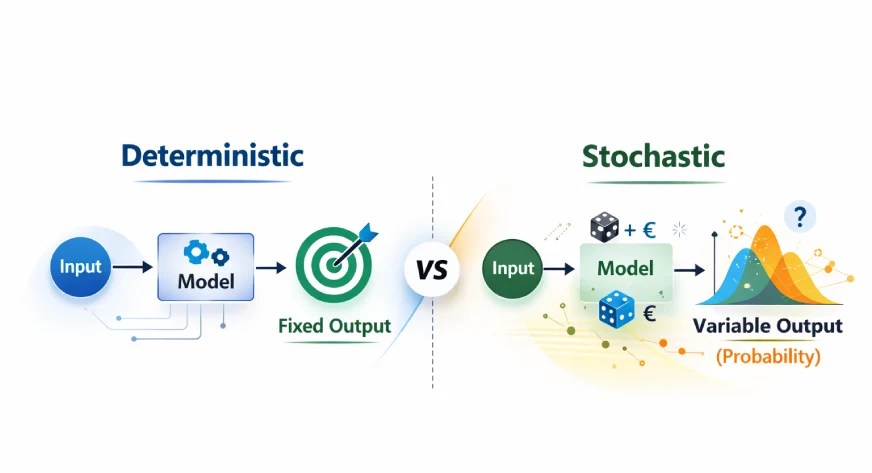
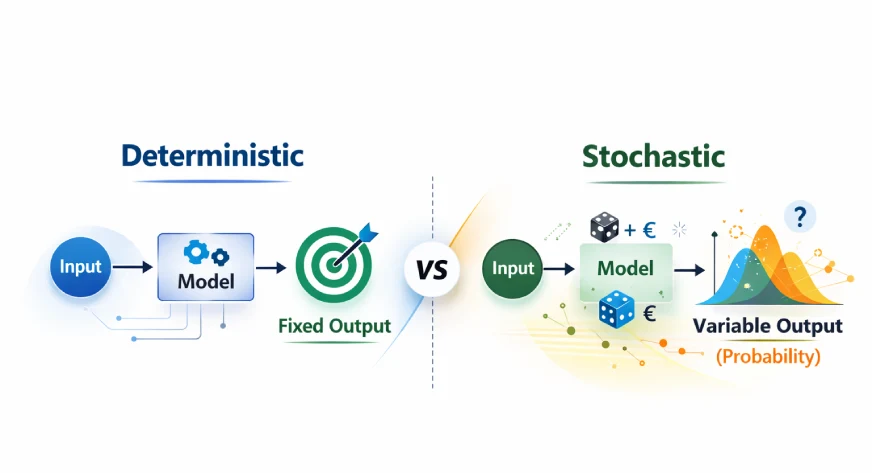
Deterministic and stochastic models are two core approaches used in machine learning, risk assessment, and decision-making systems. Deterministic models produce fixed outputs for a given input, while stochastic models incorporate randomness and probability. Understanding the difference between these approaches is essential for building reliable models and making informed predictions.
Learning Objectives:
- Understand the fundamental differences between deterministic and stochastic models
- Learn the advantages and limitations of each approach
- Explore their applications in machine learning and risk assessment
- Identify the factors that influence model choice, including data requirements, assumptions, and predictability
What Are Deterministic and Stochastic Models?
A deterministic model produces the same output every time for a given input. There is no randomness involved. The system is fully defined by its parameters and inputs.
A stochastic model includes randomness. Even with the same input, the output may vary because the model incorporates probability distributions or random variables.
The core difference lies in how uncertainty is handled:
- Stochastic models explicitly model uncertainty.
- Deterministic models assume certainty.
Mathematical Formulation
In mathematical terms, a deterministic model can be written as:
y = f(x)
Here, the output y is completely determined by the input x. If we provide the same x again, the output will always remain the same. There is no randomness involved in the mapping.
A stochastic model introduces a random component:
y = f(x) + ε
In this case, ε represents a random variable or noise term. Even if x remains the same, the value of ε may change. As a result, the output y can vary across different runs.
For example, in a simple sales forecasting model:
Deterministic version:
Sales = 5000 + 200 × Advertising Budget
Stochastic version:
Sales = 5000 + 200 × Advertising Budget + Random Market Variation
The random term reflects uncertainty due to market conditions, customer behavior, or external events.
Deterministic vs Stochastic in Machine Learning
| Aspect | Deterministic Model | Stochastic Model |
|---|---|---|
| Output | Single fixed value | Range or probability distribution |
| Randomness | None | Present |
| Uncertainty Handling | Ignored | Explicitly modeled |
| Data Requirements | Lower | Higher |
| Interpretability | High | Moderate to complex |
| Use Case | Stable and predictable systems | Uncertain and variable systems |
Pros and Cons of Deterministic Models
Pros:
- Deterministic models establish a transparent cause-and-effect relationship between inputs and outputs, facilitating a more straightforward interpretation.
- Deterministic models are computationally efficient, requiring less processing power than their stochastic counterparts.
- These models require less data for accurate predictions, which makes them suitable for scenarios with limited data availability.
Cons:
- Deterministic models assume that we know and can accurately measure all variables, a condition that may not always align with real-world complexities.
- They do not account for uncertainty and randomness inherent in many real-world situations, leading to potential inaccuracies in predictions.
Pros and Cons of Stochastic Models
Pros:
- Stochastic models consider uncertainty and randomness, rendering them well-suited for scenarios characterized by unpredictable futures.
- They offer a range of possible outcomes, enabling decision-makers to evaluate the likelihood of various scenarios and make informed choices.
Cons:
- Stochastic models demand more extensive data and computational resources than deterministic models, which may be a constraint in resource-limited situations.
- Due to the probabilistic nature of their outputs, stochastic models can be more complex to interpret, requiring a nuanced understanding of probability and statistical concepts.
Deterministic vs Stochastic: Examples
In machine learning, both deterministic and stochastic models play a crucial role. Deterministic machine learning algorithms, such as linear regression and decision trees, aim to find a fixed relationship between inputs and outputs. They provide interpretable models and are often utilized in scenarios where the data behaves predictably.
Stochastic machine learning algorithms, such as neural networks and random forests, incorporate randomness and uncertainty into the modeling process. They capture complex patterns and relationships in the data, making them suitable for uncertain future scenarios. Stochastic algorithms often outperform deterministic algorithms in image recognition and natural language processing tasks.
Practical Example – Deterministic Model in Machine Learning
Let us consider a simple Linear Regression example. Linear regression is deterministic once trained. Given the same input and trained model parameters, it will always produce the same output.
Example:
from sklearn.linear_model import LinearRegression
import numpy as np

X = np.array([[1], [2], [3], [4]])
y = np.array([2, 4, 6, 8])

model = LinearRegression()
model.fit(X, y)

prediction = model.predict([[5]])
print(prediction) Output:
... [10.]
If you run this code multiple times after training, the prediction will remain the same. There is no randomness during prediction.
This makes deterministic models suitable for systems where consistent and repeatable outputs are required.
Practical Example – Stochastic Model Behavior
Now consider a simple example of randomness using simulation. Here, we generate random values from a normal distribution.
import numpy as np

results = []

for i in range(5):
    value = np.random.normal(0, 1)
    results.append(value)

print(results) 
If you run this code multiple times, the output values will change. This demonstrates stochastic behavior.
In machine learning, stochastic behavior appears in:
- Random weight initialization in neural networks
- Mini-batch selection in Stochastic Gradient Descent
- Bootstrapping in Random Forest
Although the final trained model may behave deterministically during prediction, randomness during training helps improve generalization and avoid overfitting.
Performance and Accuracy Comparison
The performance and accuracy of stochastic vs deterministic models depend on the specific problem and dataset. Deterministic models excel in scenarios where the inputs and outputs have a clear cause-and-effect relationship. They provide interpretable models and can make accurate predictions when the underlying assumptions are met.
Stochastic models, on the other hand, excel in scenarios where the future is uncertain and unpredictable. They capture the variability and randomness in the data, allowing decision-makers to assess the likelihood of different outcomes. Stochastic models can provide more accurate predictions when the underlying assumptions of randomness hold.
Understanding Output Variability
A key difference between deterministic and stochastic models lies in output variability.
In deterministic models:
- One input produces one fixed output.
- There is no distribution of possible outcomes.
- The result is a single value.
In stochastic models:
- One input can produce multiple possible outcomes.
- The result is often represented as a probability distribution.
- Decision-makers can evaluate risk using confidence intervals or probability ranges.
For example:
Deterministic forecast:
Revenue next month = 1,000,000
Stochastic forecast:
Revenue next month is between 850,000 and 1,200,000
Probability of exceeding 1,100,000 is 20 percent
This range-based output provides more insight into uncertainty and risk.
Stochastic vs Deterministicin in Risk Assessment
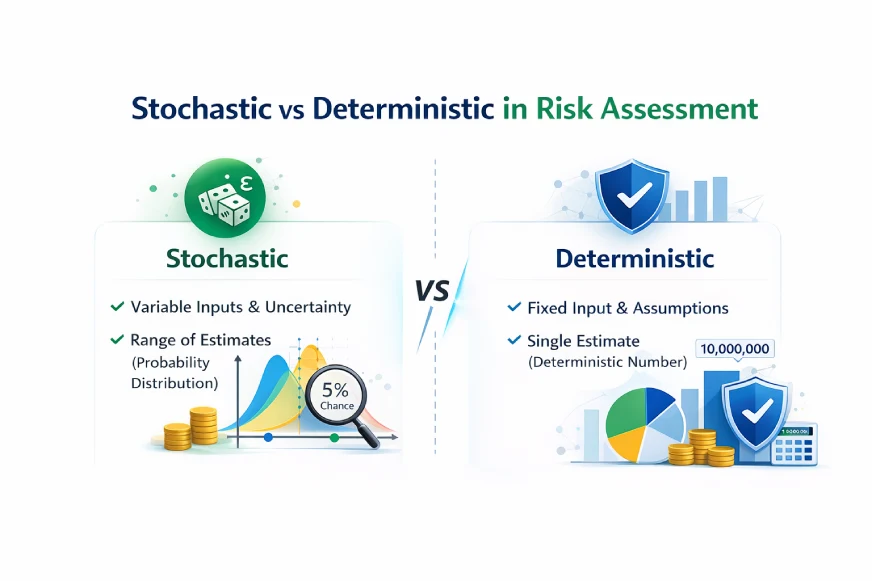
Deterministic risk assessment involves analyzing the potential risks and their impacts based on fixed inputs and assumptions. It provides a deterministic estimate of the risks and helps decision-makers understand the possible consequences of different actions. Deterministic risk assessment is commonly used in fields such as insurance and finance.
On the other hand, stochastic risk assessment incorporates randomness and uncertainty into the risk analysis process. It considers the probability of different outcomes and provides a range of possible risks. Stochastic risk assessment helps decision-makers understand the likelihood of different scenarios and make informed decisions based on the level of uncertainty.
Real-World Case Study Example
Consider an insurance company estimating annual claim losses.
Deterministic approach:
- Average claim value = 10,000
- Expected number of claims = 1,000
- Total expected loss = 10,000,000
This provides a single estimate but does not capture uncertainty.
Stochastic approach:
The company simulates thousands of scenarios using probability distributions for claim frequency and claim severity.
Results may show:
- Average loss = 10,000,000
- Minimum loss = 7,500,000
- Maximum loss = 15,000,000
- 5% chance losses exceed 14,000,000
This allows the company to prepare capital reserves based on risk levels rather than a single fixed estimate.
Robustness and Uncertainty Analysis
Deterministic risk assessment analyzes the risks based on fixed inputs and assumptions. It provides a deterministic estimate of the risks and their impacts. However, deterministic risk assessment does not account for uncertainty and variability, leading to inaccurate predictions and decisions.
On the other hand, stochastic risk assessment incorporates randomness and uncertainty into the analysis. It considers the probability of different outcomes and provides a range of possible risks. Stochastic risk assessment helps decision-makers understand the robustness of their decisions and assess the impact of uncertainty on the outcomes.
When to Choose Deterministic vs Stochastic Models
Choosing between deterministic and stochastic models depends on the nature of the problem.
Use deterministic models when:
- The system is stable and predictable
- Relationships between variables are clearly defined
- Data is limited
- You require consistent and repeatable outputs
- Interpretability is important
Use stochastic models when:
- The system involves uncertainty or randomness
- Risk analysis is required
- Future outcomes are unpredictable
- Decision-making depends on probability assessment
- Variability must be measured and quantified
In many real-world applications, hybrid approaches are used. A deterministic structure may define the main relationship, while a stochastic component captures uncertainty.
Conclusion
Stochastic and Deterministic models represent two fundamentally different approaches to modeling systems. Deterministic models provide clarity, simplicity, and repeatable outputs. They are ideal for stable environments with well-defined relationships. Stochastic models embrace uncertainty and provide probability-based insights. They are essential in risk analysis, finance, machine learning training processes, and any domain where variability matters.
Choosing the right approach depends on how much uncertainty your system contains and how much risk your decisions can tolerate.
Frequently Asked Questions
A. Determinism implies outcomes are precisely determined by initial conditions without randomness, while stochastic processes involve inherent randomness, leading to different outcomes under identical conditions.
A. An example of a stochastic process is stock market prices, where daily fluctuations are influenced by numerous unpredictable factors, leading to random changes.
A. Deterministic error is consistent and predictable, arising from systematic biases. Stochastic error is random and unpredictable, caused by inherent variability in data or processes.
A. An example of a deterministic system is a simple pendulum’s motion, which can be precisely predicted using its initial conditions and physical laws, without randomness.

Hi, I am Janvi, a passionate data science enthusiast currently working at Analytics Vidhya. My journey into the world of data began with a deep curiosity about how we can extract meaningful insights from complex datasets.
Login to continue reading and enjoy expert-curated content.
