


Support CleanTechnica’s work through a Substack subscription or on Stripe.
When my father left Utah to go as a Mormon missionary to Austria in 1927, he traveled from Utah County, Utah, by coal-burning steam train in 2 or 3 days to Chicago. There he boarded a Great Lakes steamer traveling through Lake Michigan, Lake Huron, Lake Erie, and Lake Ontario, down the Saint Lawrence Seaway, arriving a week later in Quebec City, Canada. There he boarded a ship that arrived in Liverpool, England, another week later. He traveled directly across the English Channel by ship or took the train to London and then by night train across the channel to the continent. After another full day of travel by steam train, he arrived at his first mission station in Breslau, East Germany, now Wroclaw, Poland. His total travel time was about 20 days.

A few weeks ago, our grandson drove my wife and me from Utah County, Utah, to Salt Lake International Airport where my wife, my daughter, and I took off in a Delta Airlines twin engine Airbus 330-200 with 290 other passengers. 10 hours and 10 minutes later, we landed at Charles de Gaul, Paris airport.
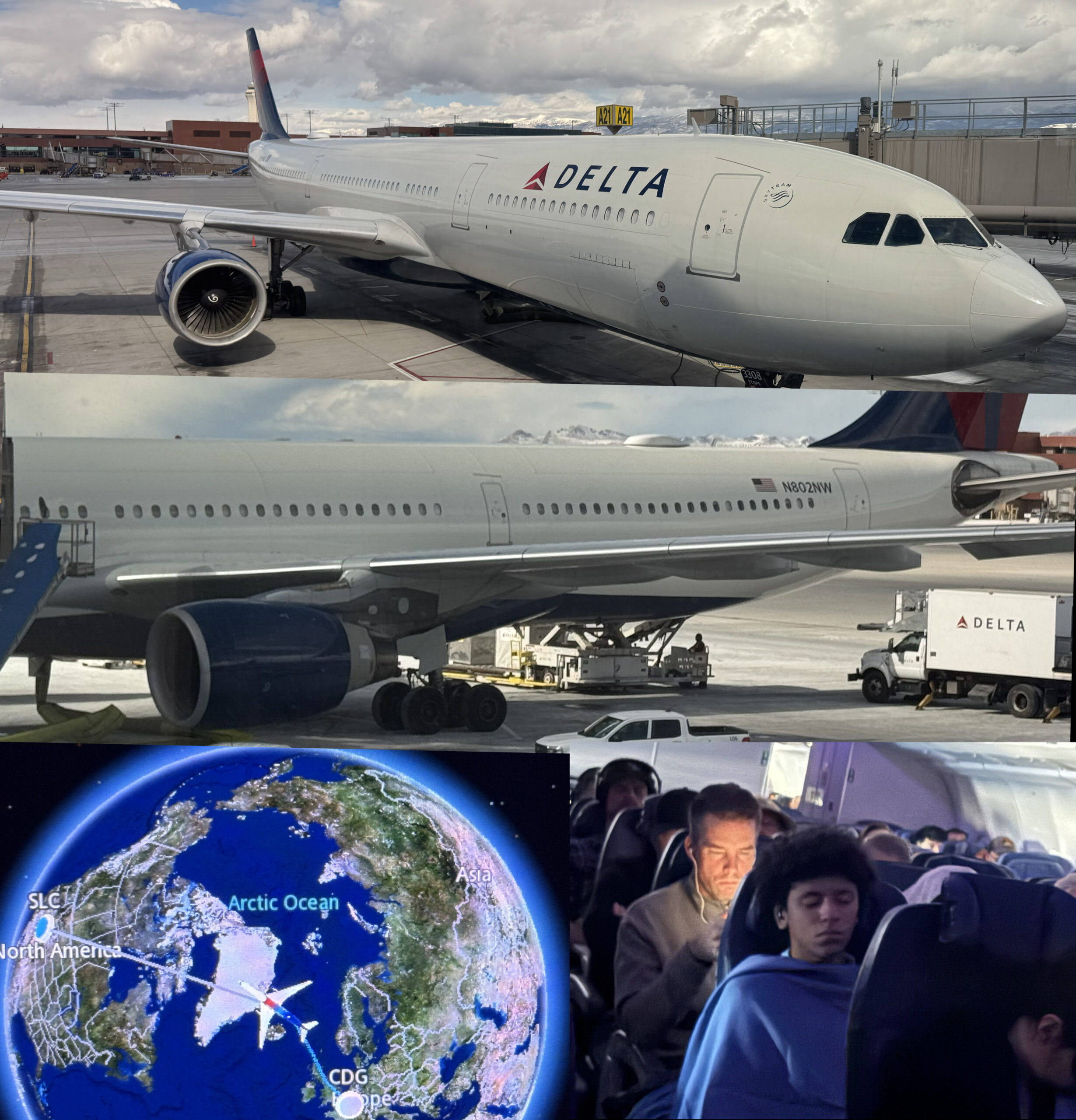
You can see from the 3D Route Map on the seat-back display that the great circle polar route over Greenland and Hudson’s Bay is far more efficient than flying first to the East Coast as we did before midsized long-range twin-engine aircraft existed. The plane was full both to and from Paris.
We rented a small Renault Cleo 6-speed manual transmission car with a diesel motor which gets 60 mpg and drove south 4.5 hours mostly on French limited-access Auto Route tollways to central France. Our total travel time was about 18 hours. There we arrived at a farm house near the small town of Bélâbre where we would be housesitting for 2 donkeys, 3 geese, 8 ducks, and a dog for the next two weeks.

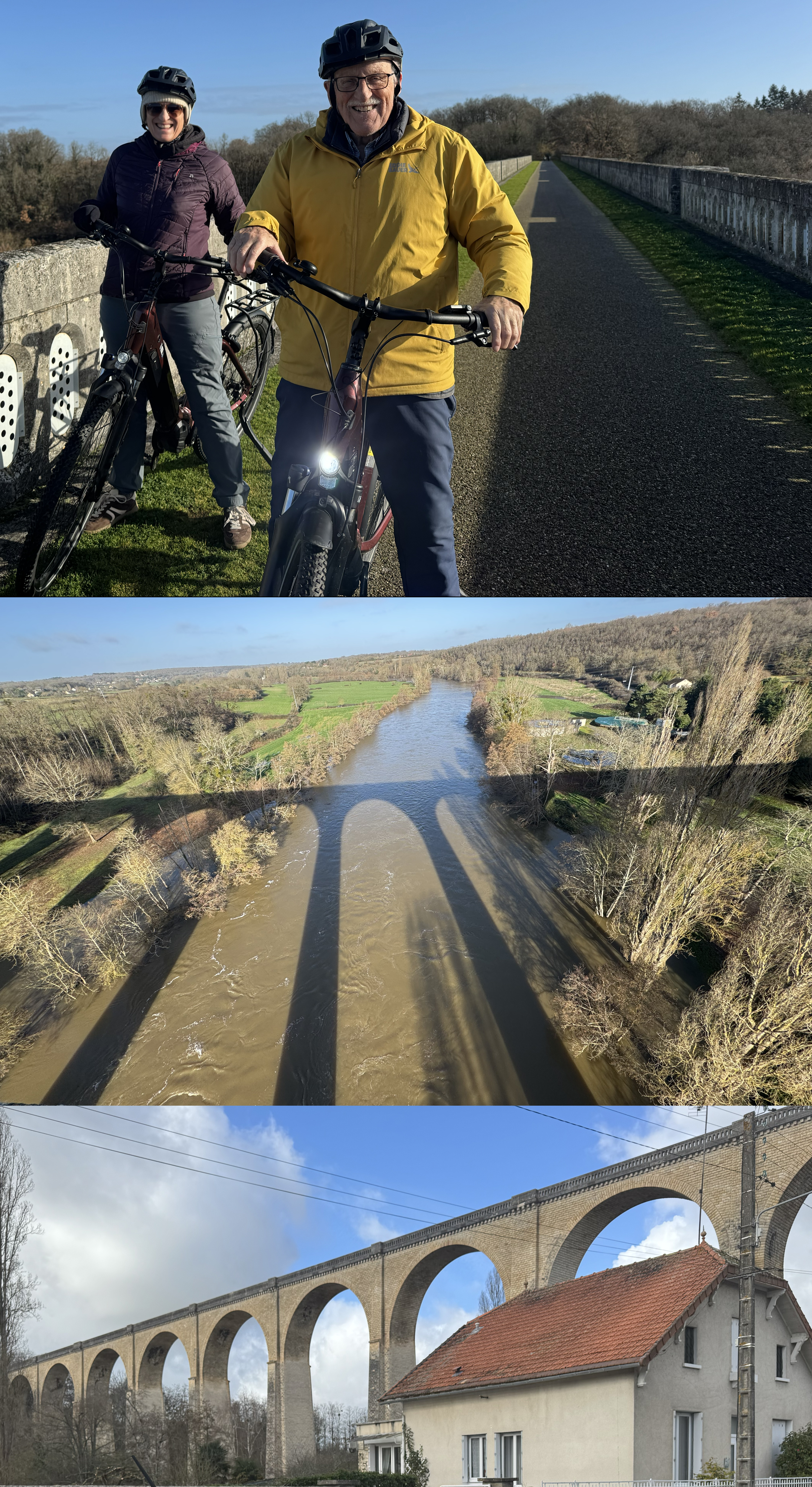
I ride an electric mountain bike about 6 days a week year around in Utah and Wisconsin here in the US. It was on my bucket list for years to ride an ebike in rural France. One of the days in France, we drove the car 8.4 miles to the bike shop in the small town of Le Blanc where my daughter and I rented ebikes. The proprietor directed us up the hill to the abandoned train station and set us off on a bike trail which used the roadbed of the railway that had once serviced the town. We were soon riding on a 100 ft high mile-long viaduct that crossed the valley and the river, as you see in the photos below. Europe, in general, and France, in particular, is serviced by extensive passenger rail systems, including high-speed trains. However, with the advent of cars, excellent roads, and tollways, the smaller towns are no longer serviced by rail.
France has an extensive Auto Route toll road system. It is roughly equivalent to our Interstate highway system, but not quite as wide and requires tolls in most locations. Teslas were common on the Auto Routes, and I assume there were frequently non-Tesla EVs passing, but they are harder for me to spot. We stopped at 4 or 5 of the full-service plazas on the Auto Routes. Every one where we stopped had EV chargers with at least 4 stalls and always a couple of EVs being charged. With the fast-food outlets and patisseries, you can grab a bite to eat while you are charging.

There are always restrooms, gas stations, EV chargers, and a number of fast-food outlets, often including Starbucks, McDonald’s, and Burger King. However, there are also frequently full-service patisseries (classic French pastry shops).

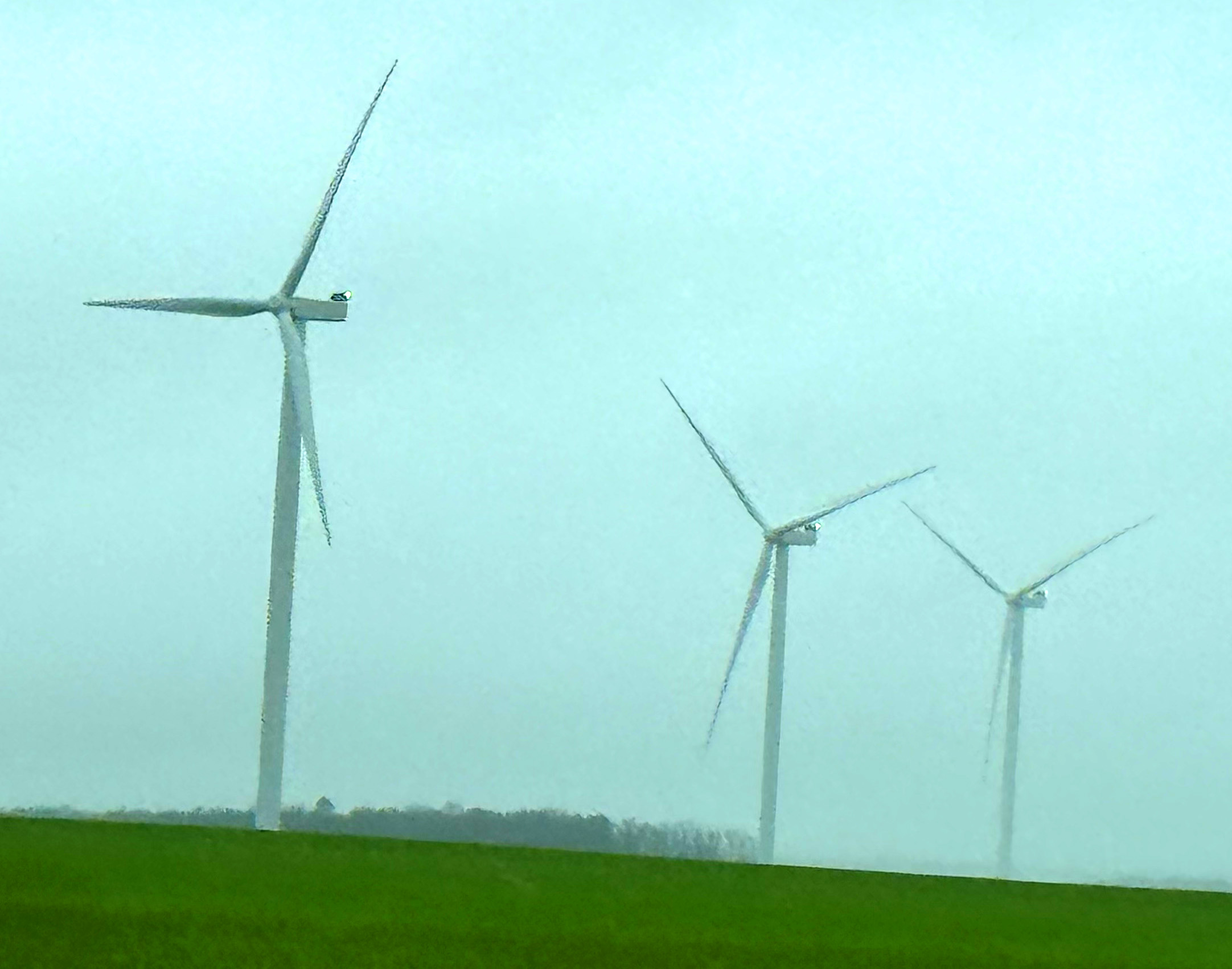
On our route south by Auto Route, we also saw huge wind turbine farms. You can see a few of the turbines below.
Travel Evolution from 1945 to the Present

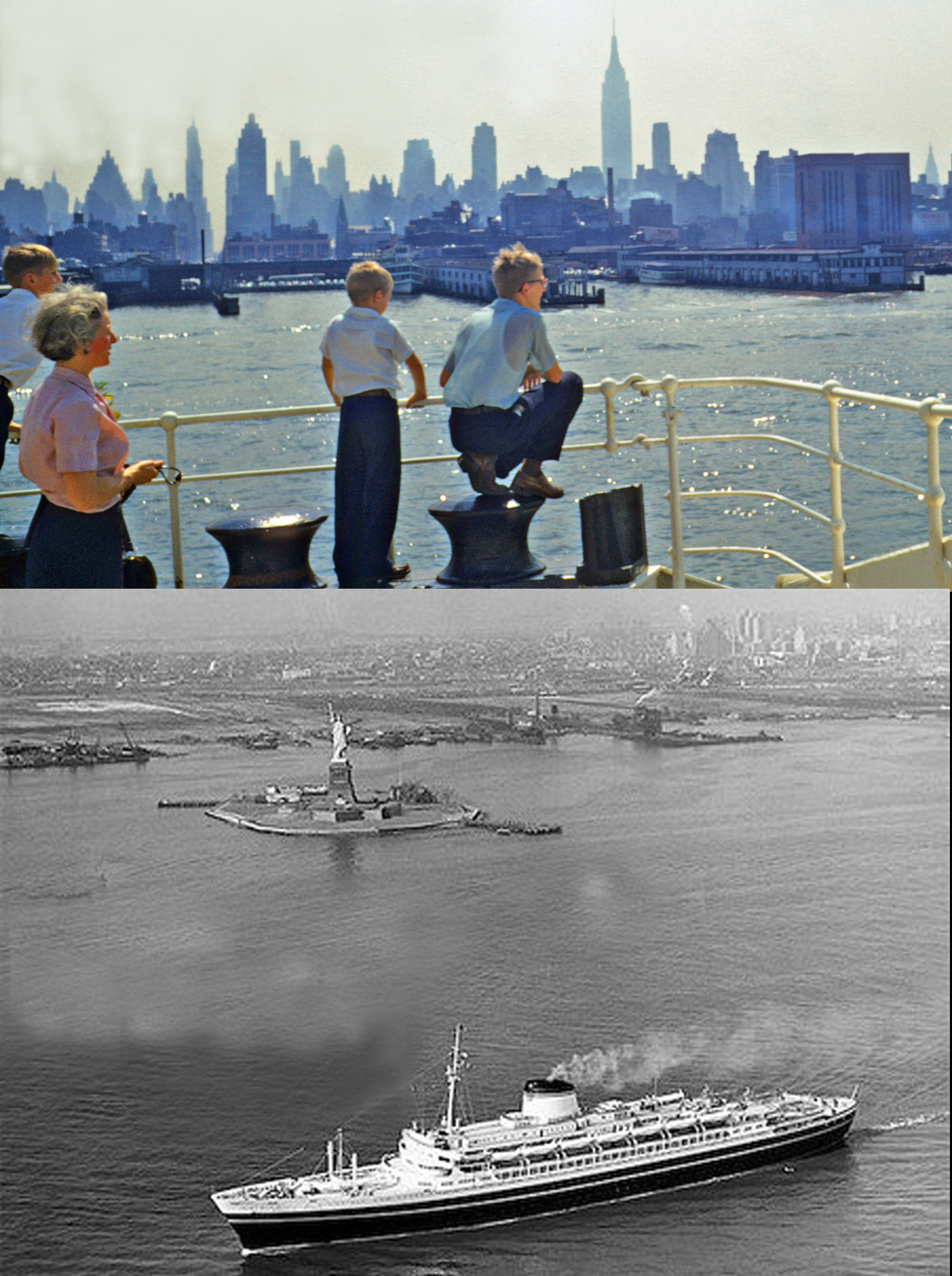
Just as World War II ended in 1945, my father served on the Strategic Bombing Survey in Germany and Austria. As an officer, he traveled by plane while the enlisted soldiers traveled by ship. When my father took all 8 of our family to spend a year in Munich, Germany 10 years later in 1954, we drove our big Nash Ambassador automobile to New York City, put it on the SS Flandre (turbine steamship), and sailed to Plymouth, England in 7 days.
A few years later in 1958, Boeing introduced the 707, a converted US Air Force midair refueling plane, which began the jet travel age. Unfortunately, only wealthy “jet setters” could afford the fares. When my future wife flew to Europe with her best friend for their dream summer in 1961, she was flying on 4-engine piston-powered aircraft.
It was the entry of the Boeing 747 4-engine jumbo jet in 1970 that reduced airfare costs so that many more people could afford to travel. When I flew for NASA from Atlanta to Johannesburg, South Africa, in May of 2000, the range of the 747 had been increased and it was still the preferred method of travel for long-distance trips all over the world. The 747-400 was the first true jumbo jet that could carry from 400 to over 600 passengers.
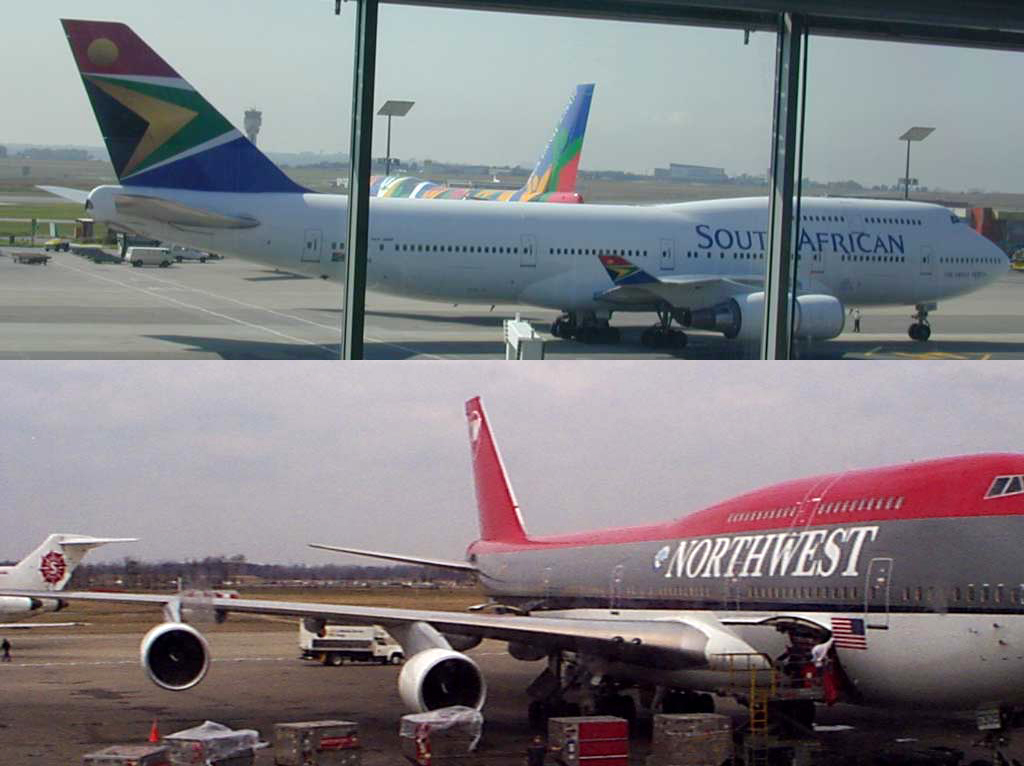
In 2007, Airbus introduced the 380 Jumbo to compete with the 747. The 380 is a 4-engine full double-deck aircraft that typically would carry 500 passengers but could carry almost 900 in an all-economy layout.
The jumbos were intended for a hub and spoke travel system where passengers would collect at major hubs like JFK, LA, and Heathrow and fly to a second hub. Meanwhile, both Boeing and Airbus were developing big long-range twins like the Boeing 777 and Airbus 320 (see photo above) that could carry up to 300 passengers on flights up to 15 hours, like Los Angeles to Sydney, Australia. Both Boeing and Airbus also developed slightly smaller but very efficient all-carbon-fibre planes, the Boeing 787 and Airbus 350. These planes introduced the long-range point to point concept like the Delta Salt Lake City to Charles de Gaul Paris flight that my family has taken a number of times recently. You can see from the seatback display photo above that great circle point to point flights with twins are much more efficient than the old hub and spoke system with 4-engine jumbo jets. The smaller twins have the ideal capacity for point-to-point flights from many more airports. Not only do they use less fuel per passenger mile, but they are crewed with only a pilot and copilot. The engineer position on the jumbos has been eliminated. Double crews are only required for ultra-long flights of over 8 hrs. like SLC to CDG and LA to Sydney. These ultra-long-range twin-engine carbon fibre planes flying point to point are much more efficient than the collector flights to 4-engine jumbo hubs of the past. When the global covid pandemic arrived in 2020, fewer people were flying and almost all the 4-engine jumbos from Boeing and Airbus were grounded, most of them permanently.
Boeing tried to introduce its 777x efficient twin engine with high-performance folding wings replacement for the jumbos with a capacity of 426 in 2020. However, the timing couldn’t have been worse. As covid hit that year, the 777x has been postponed and is now scheduled for introduction finally next year, in 2027.
Most rail transportation, most highway transportation, and even quite long ocean routes will be gradually eliminating fossil fuel. However, only short-range air travel will see conversion to electricity in the foreseeable future. Sustainable fuels made from waste/biomass are the only possible viable alternative to fossil fuel for long-range air travel in the foreseeable future. Although, synthetic fuels (e-kerosene) produced from captured CO2 and hydrogen are another possibility. Pure hydrogen fuel seems attractive until the technical problems associated with its use are carefully evaluated.
Sign up for CleanTechnica’s Weekly Substack for Zach and Scott’s in-depth analyses and high level summaries, sign up for our daily newsletter, and follow us on Google News!
Have a tip for CleanTechnica? Want to advertise? Want to suggest a guest for our CleanTech Talk podcast? Contact us here.
Sign up for our daily newsletter for 15 new cleantech stories a day. Or sign up for our weekly one on top stories of the week if daily is too frequent.
CleanTechnica uses affiliate links. See our policy here.
CleanTechnica’s Comment Policy
