


Support CleanTechnica’s work through a Substack subscription or on Stripe.
Being invited to participate in Ofgem’s eight-part Inside Energy podcast series available through their Youtube channel was an opportunity to step briefly inside the thinking of a regulator that sits at the center of the UK’s energy transition. Sharing an episode with Ofgem’s CEO Jonathan Brearley was a privilege, and about placing the UK’s challenges and choices inside a much larger global pattern that is now clearly visible. Regulators tend to operate within national boundaries and statutory mandates. Energy systems do not respect those boundaries. They are shaped by technology cost curves, supply chains, trade flows, and infrastructure decisions made far beyond any single country. That tension was at the heart of the conversation.
Inside Energy is notable because it goes beyond narrow regulatory mechanics. It traces the arc of the UK energy system from coal through oil and gas and into a period defined by electrification, renewables, and digital control. It also confronts the reality that this transition is moving faster than most projections expected even a decade ago. The series explores artificial intelligence, grid constraints, customer impacts, and investment risk, while keeping affordability and reliability in view. That framing matters, because the next phase of decarbonization is no longer about proving technologies. It is about integrating them into systems that work for millions of customers.
My contribution to the final episode was not a transcripted monologue and what follows is not a pure transcript. It is an extension of the ideas raised in the conversation with host Claire Nasir, informed by recent work across Europe, South Asia, and Africa. The common thread is decoupling, the empirical observation that economic growth and fossil fuel emissions are no longer tightly linked in much of the world.
A useful way to think about this is what is called crocodile economics. Picture GDP as the upper jaw and emissions as the lower jaw. For most of industrial history, those jaws moved together. More economic output meant more coal, oil, and gas burned. Decoupling is when the jaws begin to separate. Absolute decoupling means GDP rises while emissions fall. Relative decoupling means emissions still rise, but more slowly than GDP. Around 90% of global GDP is now in economies that have achieved one or the other, covering roughly 70% of the world’s population. That is a recent shift, not something that could be credibly claimed 15 years ago.
China is the pivotal case. For years it was an example of relative decoupling at best. In the past year, China recorded flat emissions alongside roughly 5% GDP growth, marking a transition into absolute decoupling. This matters less as a political signal than as a systems signal. China is simultaneously decarbonizing internally through massive deployments of wind, solar, storage, and transmission, while exporting the hardware that enables decoupling elsewhere. Batteries, solar panels, electric vehicles, wind turbines, and high voltage transmission equipment manufactured in China are now embedded in energy systems across the world. China is reducing the carbon intensity of its own economy while lowering the cost of decarbonization globally.
This pattern is visible beyond China. India has achieved relative decoupling, with emissions rising more slowly than GDP. Much of Southeast Asia shows the same trend. Latin America as a whole has decoupled, aided by hydropower, renewables, and biofuels. North America and Europe have achieved absolute decoupling. South America offers an instructive example at city scale. São Paulo, a metropolitan area of roughly 28 million people, has comparatively clean air for its size because Brazil adopted flex fuel vehicles decades ago, running primarily on sugarcane ethanol. These are not abstract models. They are lived outcomes.
The Netherlands illustrates how decoupling plays out in a dense, industrialized economy. The country has long been known as the gas station of Europe. Rotterdam hosts refineries, petrochemical plants, fertilizer production, and steelmaking. Around 79% of Europe’s aviation fuel is refined in the Netherlands. Starting a transition from that base is difficult. Yet the country has leaned into both centralized and decentralized solutions. Offshore and onshore wind farms operate at scale, while rooftop solar reached the highest penetration in the world for several years, exceeding even Australia on a percentage of roofs basis.
My work with the Dutch transmission system operator TenneT in 2025 highlighted how critical grid planning is in this context. High penetrations of variable renewables require both physical infrastructure and digital coordination. The Netherlands has invested heavily in both. Citizen ownership is also central. Farmers and small businesses often invest directly in wind projects, aligning local economic interest with infrastructure buildout. Decarbonization is not imposed from above. It is financed and supported from within communities.
Industrial decarbonization in the Netherlands takes pragmatic forms. Our 2050 scenario for TenneT included biogenic CO2 emissions from direction reduction of iron using biomethane being redirected to the country’s vast greenhouse sector. Dutch greenhouses consume around 5 million tons of CO2 per year to enhance plant growth. Supplying that CO2 from biogenic sources displaces fossil-derived emissions while supporting agricultural productivity. Similarly, the combined heat and power engines that powered, heated and provided CO2 for the greenhouses were preserved as very occasionally used backup, burning limited amounts biomethane for purpose, preserving capital assets and powering them with local resources.
Even water management infrastructure tells the story. The massive pumping stations that pump water into the sea from polders that once ran on diesel now use electric pumps, drawing power from wind, solar, and batteries. Electrification shows up everywhere once it begins.
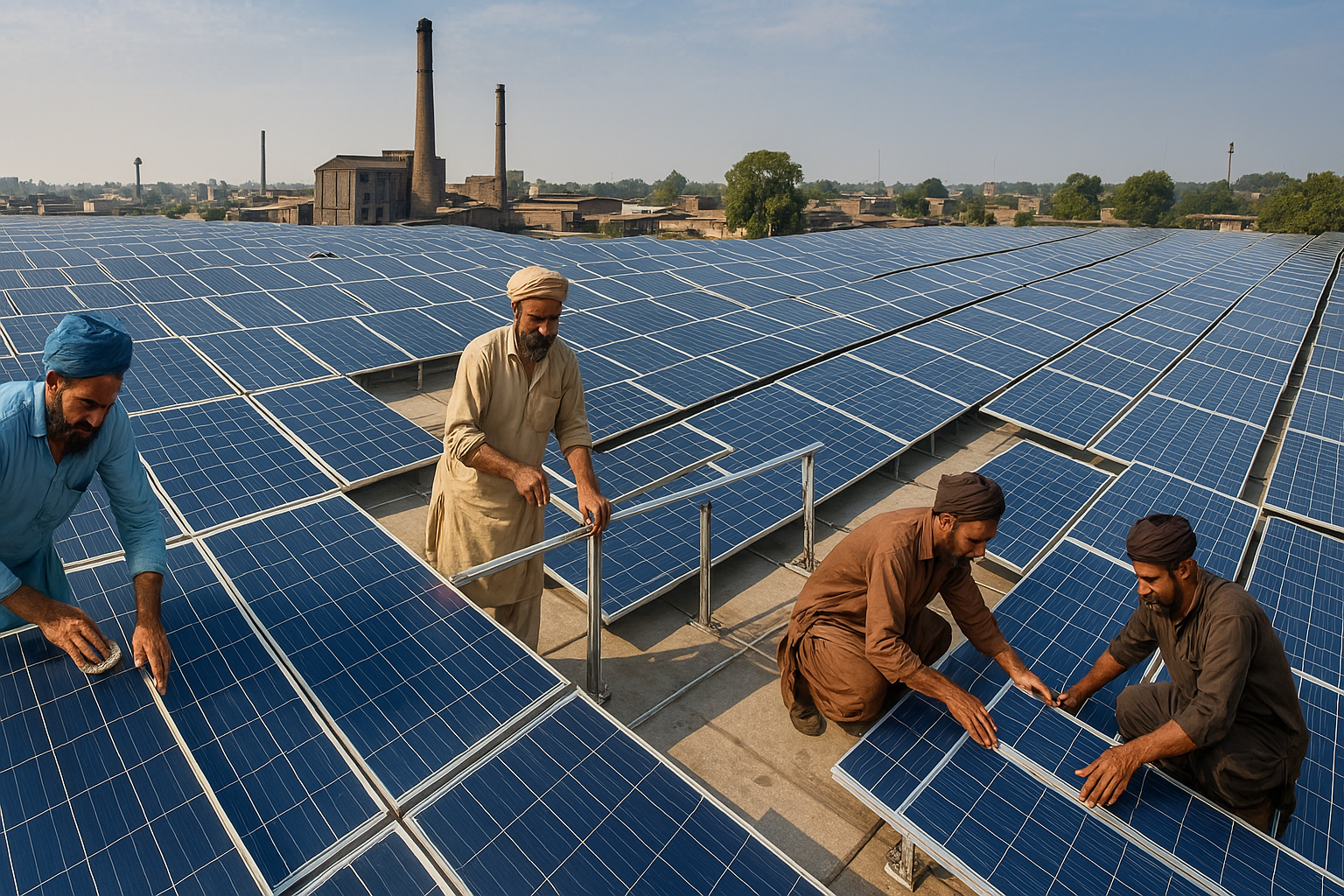
Pakistan presents a very different but equally instructive case. The country entered this decade with an unreliable grid and high electricity prices. Around 8.5% of GDP comes from textiles, an energy-intensive sector that requires both electricity and heat. When global overproduction of solar panels, largely from China, drove prices down, Pakistan’s regulators did something unusual. They largely stepped aside. They did not impose tariffs. They did not block imports. Entrepreneurs and households imported container loads of panels and installed them on rooftops, sidewalks, and industrial buildings. Informal knowledge spread through online videos. In 2024 alone, roughly 17 GW of behind-the-meter solar was installed.
This bottom-up surge was not driven by climate policy. It was driven by reliability and cost. In parallel, the state pursued top-down infrastructure upgrades. Pakistan built a high voltage direct current backbone with China Belt & Road Initiative funding and support running north to south, allowing electricity to move efficiently across the country. It also reconductored between 60% and 70% of its transmission lines, replacing steel core conductors with carbon fiber cores that sag less under heat and carry more current. Pakistan regularly experiences summer temperatures above 50°C, conditions under which older transmission lines fail. Reconductoring was not optional. It was necessary. While North America and Europe are only beginning to rediscover reconductoring, Pakistan has nearly completed the task.
These dynamics have come up repeatedly in discussions I have had with entrepreneurs considering the purchase of a privatizing Pakistani utility. Their interest is not ideological. It is grounded in the recognition that electrification combined with distributed solar and a strengthened grid offers a viable business and a more resilient system. Pakistan shows what happens when regulatory barriers are removed and infrastructure investment follows.

Africa is likely the next major region to surprise observers. The African Continental Free Trade Area was ratified and by 2024 had been signed by 48 countries. This agreement reduces trade barriers and improves market access across the continent. At the same time, imports of solar panels and batteries have risen sharply. Costs for both technologies have fallen by more than 80% over the past decade. Africa is energy impoverished today, but the building blocks for change are in place. My recent work on an African electrification flywheel outlines how falling technology costs, improved trade integration, and distributed deployment can reinforce each other. Once electrification begins at scale, it accelerates. The continent does not need to replicate fossil fuel heavy development paths. It can leapfrog directly to electric systems.
All of these cases converge on a reframing of energy security. The European energy crisis following Russia’s invasion of Ukraine made security a central concern again. Prices spiked. Supply chains fractured. Yet the most secure energy is electricity generated within national borders from wind, sun, and water. No country needs to import the wind that crosses its land or the sunlight that falls on it. Electrified systems are also more efficient. Delivering the same energy services requires only 40% to 50% of the primary energy input compared to fossil fuel systems. That efficiency reduces costs and emissions simultaneously. It also reduces spending on air and water pollution impacts, costs that rarely appear on energy bills but are paid through health systems and environmental damage.
For the UK, and for Ofgem as its regulator, these global patterns matter. The challenge is no longer whether renewables and electrification work. It is how to plan grids fast enough, how to design markets that reward flexibility, and how to ensure that customers who do not want to actively manage their energy still benefit. Electrification shifts costs from monthly fuel purchases to upfront capital investments. Heat pumps, solar panels, electric vehicles, and batteries cost more initially but less over time. Regulators must ensure that these costs are spread fairly and that benefits are accessible beyond early adopters.
The Inside Energy conversation made clear that this is not a new problem, but it is a growing one. The scale and speed of change increase complexity. Looking outward helps. The Netherlands shows how dense, industrial economies can decarbonize while maintaining competitiveness. Pakistan shows how quickly systems can change when barriers are removed and infrastructure follows. Africa shows how much potential exists where energy demand is still unmet. None of these paths are identical. All of them point in the same direction.
Sharing an episode with Ofgem’s CEO was not about closing a debate. It was about widening the lens. The crocodile’s jaws are opening. Economic growth is separating from fossil fuel emissions across most of the global economy. That separation is uneven and incomplete, but it is real. Understanding how and why it is happening elsewhere is essential for making good decisions at home.
Sign up for CleanTechnica’s Weekly Substack for Zach and Scott’s in-depth analyses and high level summaries, sign up for our daily newsletter, and follow us on Google News!
Have a tip for CleanTechnica? Want to advertise? Want to suggest a guest for our CleanTech Talk podcast? Contact us here.
Sign up for our daily newsletter for 15 new cleantech stories a day. Or sign up for our weekly one on top stories of the week if daily is too frequent.
CleanTechnica uses affiliate links. See our policy here.
CleanTechnica’s Comment Policy
