


Reaching carbon neutrality is no longer a niche goal — it’s now a core part of modern business strategy.
Companies are driven by consumer demand, investor expectations, government rules, and a growing need for long-term stability.
Becoming carbon-neutral means balancing the greenhouse gases a company produces with the same amount removed or offset from the air.
The best and most reliable way to reach this goal is by using renewable energy in daily operations.
Here’s a simple guide on how to do it.
Audit Your Energy Use
Start by running a full energy audit.
This shows how much power your business uses and where emissions come from.
Check things like:
- Your base energy needs
- Peak usage times
- The size and type of your buildings or sites
This information gives you a baseline to measure progress and spot areas for savings.
Next, build a plan that combines:
- Energy efficiency (using less energy)
- On-site renewable energy (like solar)
- Smart purchasing (buying clean energy from suppliers)
For many organizations, this journey begins with a professional feasibility assessment for renewable energy resources like solar for commercial business to understand the potential of on-site generation. This transition can help mitigate climate impact and insulate companies from volatile fossil fuel prices, creating a more predictable and sustainable cost structure.
Generate Renewable Power On-Site
Producing clean electricity on-site provides the strongest path to long-term emission reduction.
It directly displaces grid electricity—often generated from fossil fuels—and offers energy cost stability.
Solar Power (Photovoltaic Systems)
- Install panels on rooftops, carports, or unused land.
- Typical ROI: 5–7 years for commercial solar, depending on incentives.
- Federal tax credits (U.S. Investment Tax Credit) can offset up to 30% of installation costs.
Wind and Geothermal Systems
- Small wind turbines suit open, high-wind areas.
- Geothermal heat pumps provide consistent heating and cooling with 25–50% less energy use.
According to the IEA (2024), businesses adopting on-site renewables report average energy savings of 20–30%, while reducing operational emissions up to 70% when paired with efficiency upgrades.
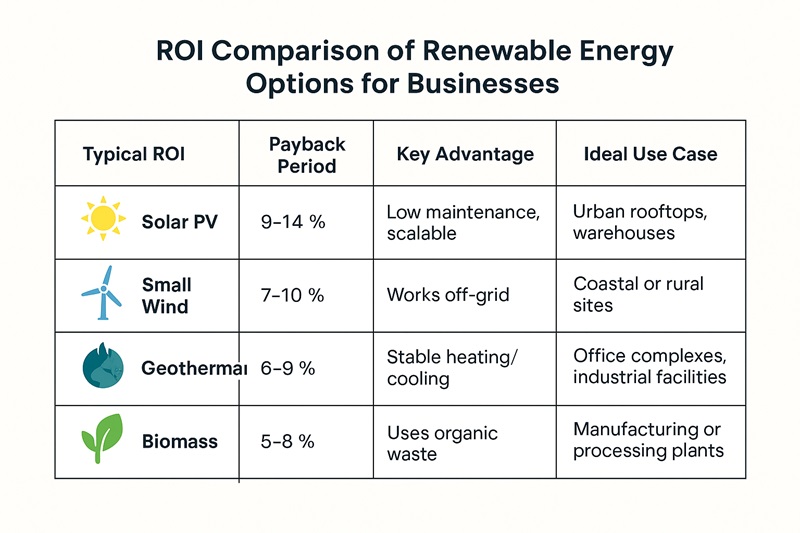
ROI and Payback Period for a 100 kW Solar System
To illustrate the financial and environmental feasibility, let’s consider a 100 kW rooftop solar PV installation for a mid-sized commercial facility in the U.S.:
| Parameter | Typical Value (2025 Estimates) | Notes |
| System Size | 100 kW DC | Standard commercial setup |
| Average Installed Cost | $180,000 – $250,000 | Around $1.80–$2.50 per watt (SEIA 2025 data) |
| Federal Investment Tax Credit (ITC) | 30 % | Reduces upfront cost to ≈ $126,000–$175,000 |
| Annual Electricity Generation | 140,000 – 160,000 kWh | Depends on solar irradiance (4–5 peak sun hours/day) |
| Annual Utility Savings | $18,000 – $24,000 | Based on $0.13–$0.15 per kWh rates |
| Simple Payback Period | 6 – 8 years | After incentives; shorter in high-rate regions |
| System Lifespan | 25 – 30 years | Panels typically warrantied for 25 yrs |
| Estimated IRR (Internal Rate of Return) | 9 % – 14 % | Comparable or better than many low-risk investments |
| Annual CO₂ Offset | ≈ 90–110 metric tons | Equivalent to removing ~25 cars/year |
Locations with higher electricity costs (California, New York, Hawaii) or strong state incentives (e.g., Illinois SREC, Massachusetts SMART) can shorten the payback to 5 years or less.
When coupled with battery storage, total investment rises 20–30 %, but peak-shaving savings and energy resilience often justify the added cost, especially for critical operations.
Explore Cost-Saving Models
Installing renewable systems can be expensive upfront, but new financing models make it easier.
One of the best options is a Power Purchase Agreement (PPA).
Here’s how it works:
- A third-party company installs and owns the system.
- Your business buys the energy it produces at a fixed, lower rate.
- You get clean power without paying large upfront costs.
Alternative Models
| Model | Ownership | Upfront Cost | Maintenance | Typical Users |
| Direct Purchase | Business | High | In-house | Large corporations |
| Lease | Third party | Medium | Shared | Retail chains |
| Energy-as-a-Service | Provider | Low | Provider | SMEs/startups |
These models stabilize long-term energy costs and protect against fossil-fuel price volatility—a growing competitive advantage in uncertain energy markets.
Procuring Renewable Energy from the Grid
Even with on-site solar or wind systems, most businesses still rely on the main power grid.
Buying renewable energy through this grid helps fill the gap and move closer to carbon neutrality.
One of the easiest ways to do this is by purchasing Renewable Energy Certificates (RECs).
A REC is created every time one megawatt-hour of renewable electricity enters the grid.
It serves as proof that clean energy was produced.
By buying RECs equal to their remaining energy use, businesses can claim renewable power use, even if the exact power they receive isn’t 100% green.
It’s best to choose certified RECs linked to new renewable projects, so each purchase helps fund more clean energy.
Large companies can also go a step further.
They can join Green Tariff programs from utilities or sign Power Purchase Agreements (PPAs).
These long-term deals let a company buy power directly from a wind or solar farm, providing price stability and funding new renewable infrastructure.
Beyond Electricity: Tackling Heat and Transport
A true carbon-neutral plan looks beyond electricity.
Many businesses also produce emissions from heating and transportation.
For heating or industrial use, renewable options include:
- Biomass boilers for clean heat
- Solar thermal systems for hot water
- Geothermal systems that use the earth’s steady temperature
For transport, switching to electric vehicles (EVs) is key.
Businesses can replace fleet vehicles and install EV chargers for staff and customers.
When powered by renewable electricity, these vehicles help reduce emissions even more — creating a strong cycle of sustainability across operations.
Verification, Certification, and Continuous Improvement
Reaching carbon neutrality is not something a company can simply claim.
It must be verified through recognized international standards.
Independent certification bodies check how a business measures, reduces, and offsets its emissions.
They review greenhouse gas data, confirm Renewable Energy Certificate (REC) purchases, and ensure all claims are accurate and transparent.
If a company still has emissions it cannot eliminate, it can buy high-quality carbon offsets.
These funds support projects like tree planting, forest restoration, or methane capture, which help remove carbon from the atmosphere.
Carbon neutrality is not a one-time milestone — it’s a continuous journey.
Each year, businesses should reassess energy use, track new technologies, and look for more ways to cut emissions.
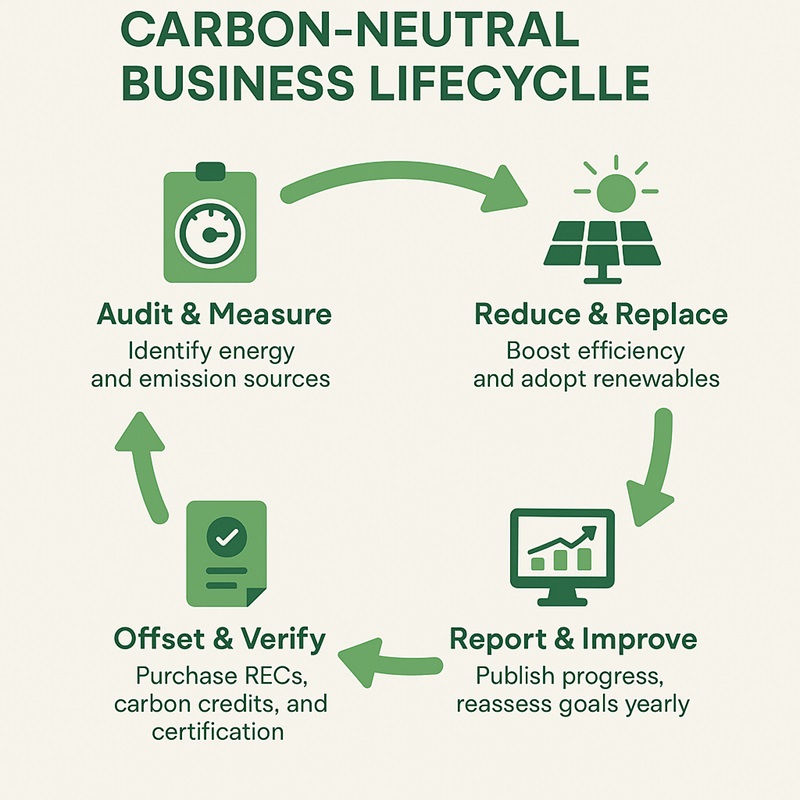
Feasibility and Practical Implementation Roadmap
Transitioning to renewables is both an environmental and strategic business investment.
Below is a realistic sequence small to large companies can follow:
| Phase | Timeline | Key Actions |
| Assessment | 0–6 months | Energy audit, baseline calculation, stakeholder buy-in |
| Efficiency First | 6–12 months | LED upgrades, HVAC optimization, automation systems |
| On-Site Deployment | 1–3 years | Solar/wind/geothermal installation, monitoring setup |
| Procurement & Offsets | 2–4 years | RECs, PPAs, certified offset purchases |
| Verification & Reporting | Ongoing | Third-party audits, disclosure to CDP or SBTi |
The approach scales: even SMEs can start small (LEDs + RECs), while enterprises integrate multi-site PPAs and global sustainability reporting.
Conclusion: Building a Carbon-Neutral Future
Using renewable energy to reach carbon neutrality involves four main steps:
audit, generation, procurement, and verification.
It’s more than a green goal — it’s a smart business investment.
Adopting renewables strengthens a company’s reputation, resilience, and long-term profitability.
By following these steps, businesses can create strong, low-carbon operations ready for the future.
Those who lead this change won’t just meet market standards — they’ll set them, shaping a cleaner and more sustainable world for decades to come.
