


Any modern business has to meet a growing number of IT needs to ensure its successful development and high competition in the market. To cope with all the IT activities effectively and stay focused on delivering their core services or a product, businesses often refer to professional IT outsourcing companies.
IT outsourcing solutions allow businesses to optimize their spendings on IT services, complete their daily IT tasks on a professional level, and increase their operational efficiency. For this, IT outsourcing companies offer a variety of engagement models. The most popular are staff augmentation, complete product development outsourcing, or hiring a dedicated team of experts. In this article, we look into the pros and cons of the two most popular models: staff augmentation and IT project outsourcing, and explain when to choose one over the other.
IT Staff Augmentation
What is staff augmentation in IT outsourcing? Staff augmentation is one of the types of software outsourcing services where staff augmentation companies provide their specialists on a temporary basis to enhance in-house team performance. Usually, IT companies offer staff augmentation on a Time and Materials contract when their clients pay for IT staff on an hourly basis and the materials needed to complete the project.

Let’s have a more detailed look at the IT staff augmentation service, its evident benefits, and hidden drawbacks.
Key Benefits of Staff Augmentation
- Cost-efficiency. IT staff augmentation helps to reduce hiring and onboarding costs as well as full-time wages and benefits, which are inevitable in in-house employment. As a result, you pay only for the actual hours spent on your project, cutting short-term and long-term expenses.
- Fast onboarding of narrow specialists. Finding the right specialist in your area can be a challenging task. IT staff augmentation allows your business to tap into the talent pool of experienced and trained IT professionals and find the specialists most suitable for your IT projects.
- Seasonal employment. IT staff augmentation provides flexible schemes for engaging with external teams. It means that you can add IT professionals when you require them at most and downsize them when their support isn’t necessary anymore. For example, to opt for a resource augmentation model to complete a particular project or to support your in-house team with supplementary staff during the pickloads. Moreover, it’s much easier to terminate a staff augmentation contract than to reduce or even fire the in-house team members.
- In-house management. When opting for staff augmentation, it implies that the external team will work directly with your in-house team. They will follow the internal work regulations and report directly to your managers. It means that your managers and team leads will consider when and where they need to fill in the skill gaps with the needed IT specialists.
Staff Augmentation Drawbacks
- Management capability. When hiring an external team, your company managers should be prepared to manage more people, provide additional guidance, and much more.
- Additional training and integration. Although an external team will obtain the necessary IT skills, your managers will still have to explain your company’s internal processes and inner policies. Moreover, when you add new specialists to an already existing team, you need to allocate time to the newcomers to learn the company procedures and rules.
Project Outsourcing
What does project outsourcing mean, and why opt for it when there is staff augmentation?
Project outsourcing is the model when a business hands over its entire project development to IT outsourcing professionals. It means that IT outsourcing clients don’t have to worry about team management or office preparation to welcome new employees. Instead, they can focus on their core competencies while all the IT work is done by the professionals.
IT project outsourcing involves a team of experts who are ready to assume project management tasks, as well as all the software development processes. The project team will work separately from your in-house team, and it doesn’t get involved in any in-house business activities.

What can you gain from the IT project outsourcing services? Let’s take a look at its key benefits.
Key Benefits of Outsourcing
- Reduction in costs. When you outsource your IT development projects, just like in the case of staff augmentation, you don’t have to invest in staff recruiting, onboarding, and training, as well as care about their payroll or bonuses. This allows to significantly reduce the costs inevitable in in-house hiring.
- Quick project start. For internal teams, it can take a long time before the project gets off the ground. The team may require additional training, hiring narrow specialists, or buying special equipment to start the project. Whereas in project outsourcing, the team handles full-cycle development of the project from documentation development to the product release and its maintenance.
- Technical and management arrangement. When outsourcing your projects, you don’t have to bother about finding extra space to arrange working places for the new employees, nor worry about buying licensed software or hardware. Moreover, IT outsourcing companies undertake the responsibility of employee selection and their training. As a result, you get an all-set team for a fixed price.
- Reduced risks. IT outsourcing companies provide highly skilled specialists who assume the responsibility for project outcomes. As a result, they accept the risks associated with the development of your digital solution.
- Offloading an in-house team. With IT project outsourcing, you can focus on your core business aims and offload your in-house employees, focusing them on more important business tasks. This way, your managers can gain more flexibility and work on the projects falling under your company’s particular area of expertise.
Outsourcing Drawbacks
- Less flexibility. Compared to the staff augmentation model, outsourcing may be less flexible when it comes to making rapid changes. Adjusting scope, priorities, or team composition often requires additional approvals and may impact timelines.
- Dependency on the vendor. With outsourcing, much of the project success depends on the capabilities and reliability of the outsourcing partner. Changing vendors mid-project can be complex and time-consuming.
Key differences: Staff Augmentation vs Outsourcing
To better understand the key differences between staff augmentation and outsourcing, it is important to compare these models in terms of key factors: level of control, team management, flexibility, and impact on business processes. Below is a clear comparison to help you determine which model best suits your specific needs, current workflow, and overall business strategy.
| Criteria | Staff Augmentation | Outsourcing |
| Control | Full control over augmented staff | Limited control — managed by the vendor |
| Management | Managed by your project manager and in-house team | Managed by a third-party vendor or outsourcing partner |
| Workflow Integration | Fully integrated into your internal workflow and processes | Vendor’s own workflow, partially isolated |
| Flexibility | High — easy to scale the team based on specific needs | Medium — changes require coordination with the vendor |
| Pricing Model | Pay-per-hour (Time & Materials) | Fixed price or hybrid model |
| Use of Third-Party Resources | Targeted involvement of specialists for specific tasks | Full delegation to a third-party outsourced team |
| Oversight Level | Direct oversight and involvement in daily operations | Minimal control, focus on final results |
| Task Approach | Ideal for covering specific needs and skill gaps | Suitable for delivering a specific project end-to-end |
| Impact on Business Processes | Maintains control over business logic and strategy | Part of processes delegated to an external team |
| Company Focus | Retains full focus on product development and management | Allows focus on core business activities |
Key differences: Staff Augmentation vs Outsourcing
As the comparison shows, the staff augmentation model is suitable for companies that need to retain full control, scale their team flexibly and bring in specialists with specific skills without long-term commitments. At the same time, outsourcing is a more effective option if you wish to reduce the workload on your in-house team, delegate processes to an external vendor, and focus on key business areas.
When choosing between staff augmentation and outsourcing, it is important to consider not only the budget but also the level of in-house expertise, the need for control, and the project’s strategic objectives.
Choosing Between Staff Augmentation and Outsourcing: What Works Best for Your Business?
The choice between staff augmentation and outsourcing largely depends on the role you wish to retain for your team and the extent to which you plan to be involved in the development process.

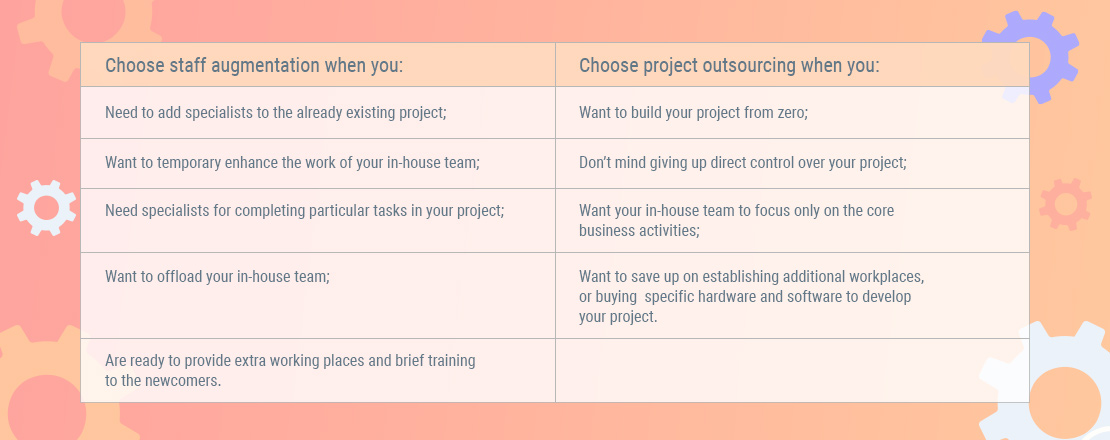
If you already have an in-house team and well-established processes, but are lacking specific specialists or expertise, it makes sense to consider a staff augmentation model. This approach allows you to strengthen your team in specific areas by bringing in skilled professionals, tackle specific tasks, and retain control over the project and your internal workflow.
If, however, you are planning to launch a project from scratch or do not wish to get bogged down in day-to-day operations, outsourcing may be a more suitable option. In this case, tasks are handed over to an external vendor, allowing your team to focus on strategic priorities and business development.
In practice, the choice often boils down to a simple question: do you want to manage the process yourself or delegate it to an external team?
A Quick Summary on Staff Augmentation and Outsourcing Model
Here is a quick summary of the key points for you to refer to when choosing one model over another.
What SCAND Offers: Flexible Engagement Models for Team Scaling
SCAND provides a range of flexible engagement models that help businesses efficiently scale their development teams while maintaining the required level of control, flexibility, and cost efficiency. Depending on the project scope and internal capabilities, companies can choose the most suitable collaboration format to support their goals.
One of the key advantages of our approach is team stability and transparency. Clients are directly involved in selecting the specialists who will work on their projects. Once approved, the team remains consistent throughout the engagement, ensuring continuity, deeper product knowledge, and long-term efficiency.
We also follow a result-oriented engagement model. Clients are invoiced only after the work has been completed, which provides an additional level of confidence and reduces financial risk. This approach allows companies to evaluate actual performance before committing to ongoing collaboration.
Another important benefit is flexibility with minimal obligations. Our clients are not tied to long-term commitments and can scale their augmented staff up or down depending on project needs. If priorities change, cooperation can be adjusted or paused without complex contractual constraints.
Compared to traditional outsourcing approaches, SCAND’s engagement models allow companies to:
- avoid recruitment and onboarding overhead
- reduce infrastructure and operational costs
- retain full control over workflows and decision-making
- access highly skilled professionals on demand
With over 25 years of experience in bespoke software development, SCAND helps companies build effective teams and achieve their business goals, striking a balance between control, flexibility, and results.
Our engagement models include Outstaffing, Time & Materials, Fixed Bid, and Dedicated Team, allowing us to select the optimal approach based on each client’s specific needs, project requirements, and long-term business strategy.
