
Close Menu
  • Home
  • AI
  • Big Data
  • Cloud Computing
  • iOS Development
  • IoT
  • IT/ Cybersecurity
  • Tech
    • Nanotechnology
    • Green Technology
    • Apple
    • Software Development
    • Software Engineering

Subscribe to Updates

Get the latest technology news from Bigteetechhub about IT, Cybersecurity and Big Data.

    What's Hot

    Setting Up a Google Colab AI-Assisted Coding Environment That Actually Works

    March 11, 2026

    The economics of enterprise AI: What the Forrester TEI study reveals about Microsoft Foundry

    March 11, 2026

    The search for new bosons beyond Higgs – Physics World

    March 11, 2026
    Facebook X (Twitter) Instagram
    Facebook X (Twitter) Instagram
    Big Tee Tech Hub
    • Home
    • AI
    • Big Data
    • Cloud Computing
    • iOS Development
    • IoT
    • IT/ Cybersecurity
    • Tech
      • Nanotechnology
      • Green Technology
      • Apple
      • Software Development
      • Software Engineering
    Big Tee Tech Hub
    Home»Nanotechnology»Searching for dark matter particles – Physics World
    Nanotechnology

    Searching for dark matter particles – Physics World

    big tee tech hubBy big tee tech hubOctober 17, 2025012 Mins Read
    Share Facebook Twitter Pinterest Copy Link LinkedIn Tumblr Email Telegram WhatsApp
    Follow Us
    Google News Flipboard
    Searching for dark matter particles – Physics World
    Share
    Facebook Twitter LinkedIn Pinterest Email Copy Link


    A research team from China and Denmark have proposed a new, far more efficient, method of detecting ultralight dark matter particles in the lab

    Dark starry sky

    Dark matter does not interact with electromagnetic waves directly and is notoriously difficult to detect (Courtesy: iStock/gschroer)

    Dark matter is hypothesised form of matter that does not emit, absorb, or reflect light, making it invisible to electromagnetic observations. Although we have never detected it, its existence is inferred from its gravitational effects on visible matter and the large-scale structure of the universe.

    The Standard Model of particle physics does not contain any dark matter particles but there have been several proposed extensions of how they might be included. Several of these are very low mass particles such as the axion or the sterile neutrino.

    Detecting these hypothesised particles is very challenging, however, due to the extreme sensitivity required.

    Electromagnetic resonant systems, such as cavities and LC circuits, are widely used for this purpose, as well as to detect high-frequency gravitational waves.

    When an external signal matches one of these systems’ resonant frequencies, the system responds with a large amplitude, making the signal possible to detect. However, there is always a trade-off between the sensitivity of the detector and the range of frequencies it is able to detect (its bandwidth).

    A natural way to overcome this compromise is to consider multi-mode resonators, which can be viewed as coupled networks of harmonic oscillators. Their scan efficiency can be significantly enhanced beyond the standard quantum limit of simple single-mode resonators.

    In a recent paper, the researchers demonstrated how multi-mode resonators can achieve the advantages of both sensitive and broadband detection. By connecting adjacent modes inside the resonant cavity, and  tuning these interactions to comparable magnitudes, off-resonant (i.e. unwanted) frequency shifts are effectively cancelled increasing the overall response of the system.

    Their method allows us to search for these elusive dark matter particles in a faster, more efficient way.
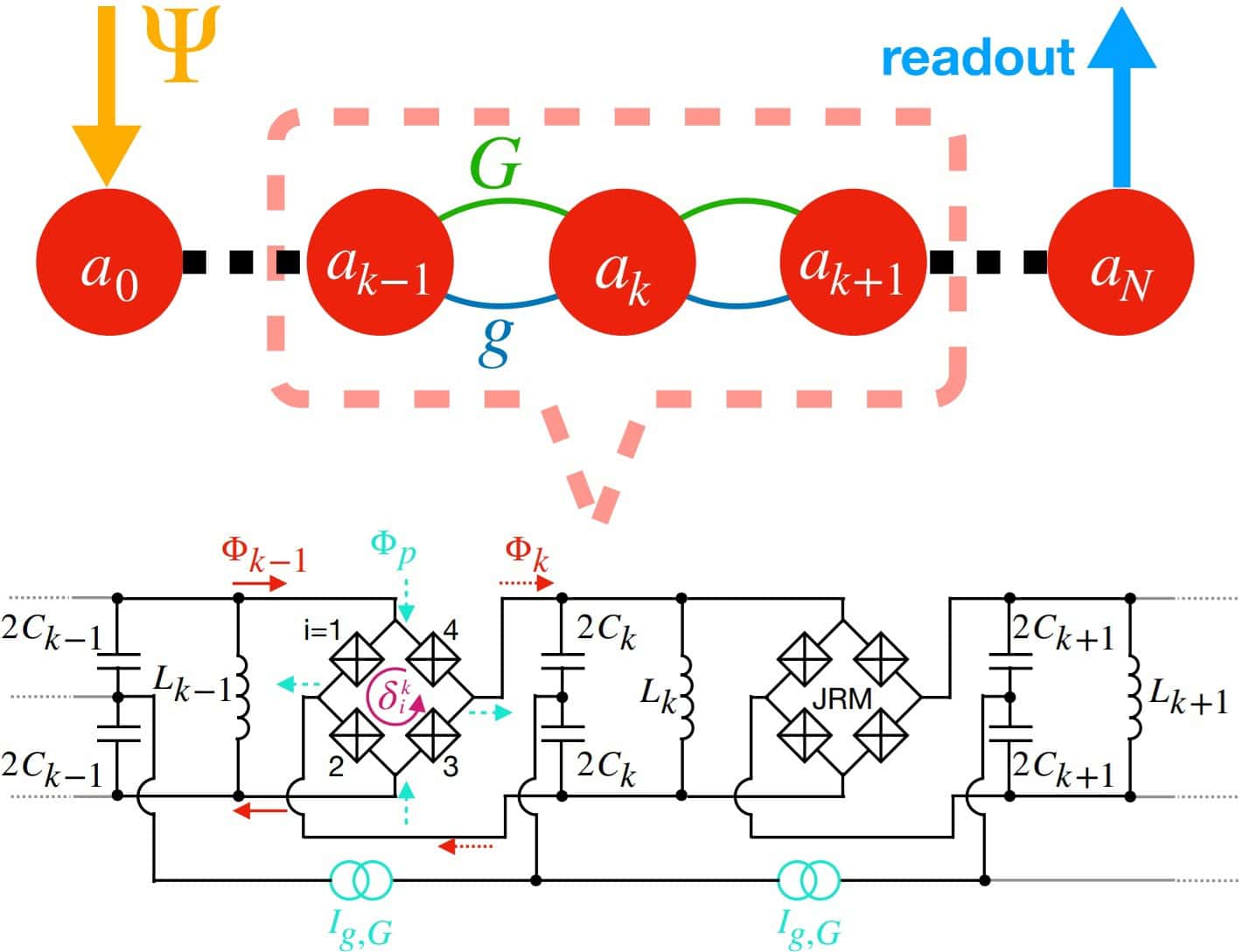
    Dark matter detection circuit
    A multi-mode detector design, where the first mode couples to dark matter and the last mode is read out (Courtesy: Y. Chen)


    Source link

    dark Matter particles Physics Searching World
    Follow on Google News Follow on Flipboard
    Share. Facebook Twitter Pinterest LinkedIn Tumblr Email Copy Link
    tonirufai
    big tee tech hub
    • Website

    Related Posts

    The search for new bosons beyond Higgs – Physics World

    March 11, 2026

    How Pokémon Go is giving delivery robots an inch-perfect view of the world

    March 11, 2026

    Next Generation, Permanent DNA-Based Data Storage for the AI Age

    March 10, 2026
    Add A Comment
    Leave A Reply Cancel Reply

    Editors Picks

    Setting Up a Google Colab AI-Assisted Coding Environment That Actually Works

    March 11, 2026

    The economics of enterprise AI: What the Forrester TEI study reveals about Microsoft Foundry

    March 11, 2026

    The search for new bosons beyond Higgs – Physics World

    March 11, 2026

    Amazon is linking site hiccups to AI efforts

    March 11, 2026
    About Us
    About Us

    Welcome To big tee tech hub. Big tee tech hub is a Professional seo tools Platform. Here we will provide you only interesting content, which you will like very much. We’re dedicated to providing you the best of seo tools, with a focus on dependability and tools. We’re working to turn our passion for seo tools into a booming online website. We hope you enjoy our seo tools as much as we enjoy offering them to you.

    Don't Miss!

    Setting Up a Google Colab AI-Assisted Coding Environment That Actually Works

    March 11, 2026

    The economics of enterprise AI: What the Forrester TEI study reveals about Microsoft Foundry

    March 11, 2026

    Subscribe to Updates

    Get the latest technology news from Bigteetechhub about IT, Cybersecurity and Big Data.

      • About Us
      • Contact Us
      • Disclaimer
      • Privacy Policy
      • Terms and Conditions
      © 2026 bigteetechhub.All Right Reserved

      Type above and press Enter to search. Press Esc to cancel.