


Termites are sneaky little critters and that’s why they cause so much damage before you even notice they’re there. They tend to hide in wood, behind walls, under floors or close to the foundations of homes – sometimes for years – before you see any sign of the problem. By the time you spot them, it’s often too late, and the US Environmental Protection Agency says that lots of homeowners only find out they have termites when they see a swarm or stumble upon some damage while doing some building work or renovations.
So, what do termites actually look like?
For starters, termites are small insects with soft, squishy bodies that are usually a pale cream, white or light brown colour. Flying termites, which are normally called swarmers, are a bit darker and stand out a bit more. But here’s the thing: unlike ants, termites have straight antennae and a slightly thicker waist area, and when they’re flying around, they have two pairs of wings that are roughly the same length. But the thing is, spotting termites isn’t just about spotting the insects themselves. Its also about the signs and clues left behind – like where they leave bits of their wings, mud tubes, bits of hollow sounding wood or general damage that just seems to have appeared out of nowhere.
In Simple Terms – What Do Termites Look Like?
Termites are smallish insects with squishy bodies and straight antennae, and they come in a variety of colours. They’re usually pale white, cream, or light brown, although worker termites look fairly similar but tend to have a slightly bigger and darker head. Flying termites on the other hand are usually a bit darker – brown or blackish – and they’ve got two pairs of equal length wings. That length of wings plus the straight antennae and a nice broad waist shape makes it pretty easy to tell them apart from flying ants.
The Science Behind How Termites Look
The reason termites don’t all look the same is because they all do different jobs within their colonies. Their colour, size and shape changes with what they’re doing, which is why you’ll often hear entomologists and people in the extension services break them down into workers, soldiers and reproductives (or swarmers for short).
Termite Sizes, Shapes and Colours
Most worker termites are a pale white, cream or light tan colour. They’re a bit pale because they tend to stay hidden in wood and soil, which means they don’t really need the darker colours that insects that get more exposure tend to need. But then there are the swarmers which are often a bit darker, often more brown or blackish in colour and so much easier to spot. They tend to be about a quarter of an inch long, but this can vary between species.
Termites, like all insects, have the usual three bits to their body – the head, the thorax, and the abdomen. They’ve also got six legs and two antennae, but its the simpler traits that make them easier to spot – straight antennae, a nice broad waist with no pinch in the middle and, in winged termites, four wings that are roughly the same length.
Why different termites look so darn different
A termite’s appearance is largely determined by what their job is in the colony. Workers are all about feeding, tunnel maintenance and taking care of the colony so they’re small, pale and wingless. Soldier termites are the defenders, hence they have bigger, more obvious heads and jaws. Then there are the swarmers – the reproductive termites whose job is to leave the colony and start new ones – they’re dark, winged and pretty noticeable.
How termites develop & grow
Termites go through a bit of a complex life cycle – they develop through a form of incomplete metamorphosis which basically means they grow gradually from egg to nymph to adult through a series of molts. This is important to know when trying to identify a termite because the young ones can look a lot like the lighter-bodied ones in the colony rather than suddenly becoming a completely different-looking insect.
Where termites come from
Termites are social insects that live in colonies, each with their own specialized roles within the colony. If you’re interested in learning more about where they fit in, they’re pretty closely related to cockroaches. That’s handy to know but mainly just provides some background.
Seasonal termite issues
In many parts of the US, homeowners tend to notice termites most when swarming season hits, which is usually in the spring or during warm humid weather. That’s when the reproductive termites come out, fly around and shed their wings near windows doors and lights. But the colony itself may have been up to all sorts of mischief long before that. In warmer regions, termites are active and eating year round and you might not even see them.
How to identify a termite at a glance
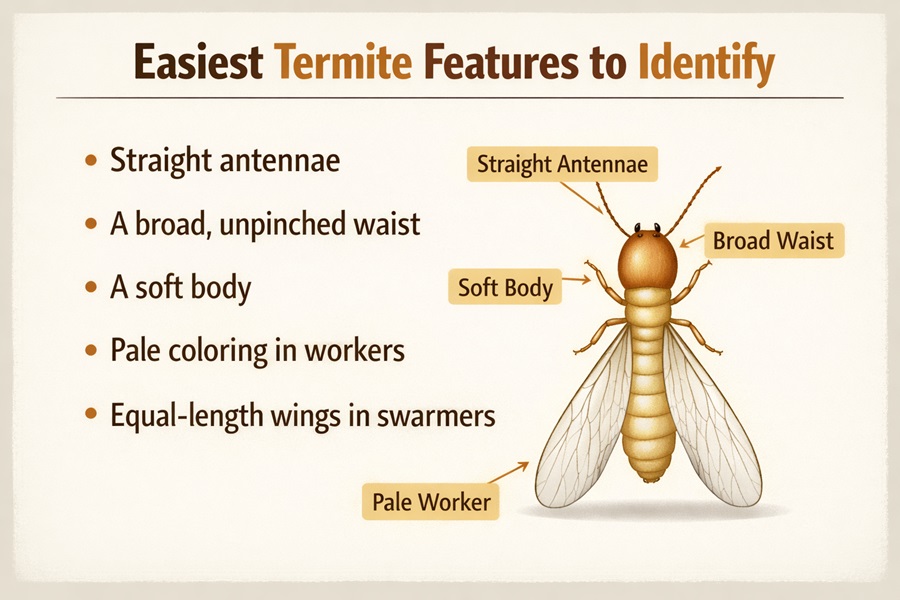
If you ever get up close to a termite, you’ll probably notice it looks quite different to other insects around the house. Termites tend to be lighter, softer and less sharply defined than a lot of other common household insects, and workers can appear almost translucent. Compare that to ants – termites don’t have that pinched middle bit, and they don’t have that shiny hard bodied look either.
The things that are easiest to spot are:
- straight antennae
- a broad unpinched waist
- a soft body
- pale coloring in workers
- equal length wings in swarmers
All this is important because a lot of homeowners expect all termites to be white, but the truth is, swarmers are often darker, which is one reason they get mistaken for ants.
What do different types of termites look like
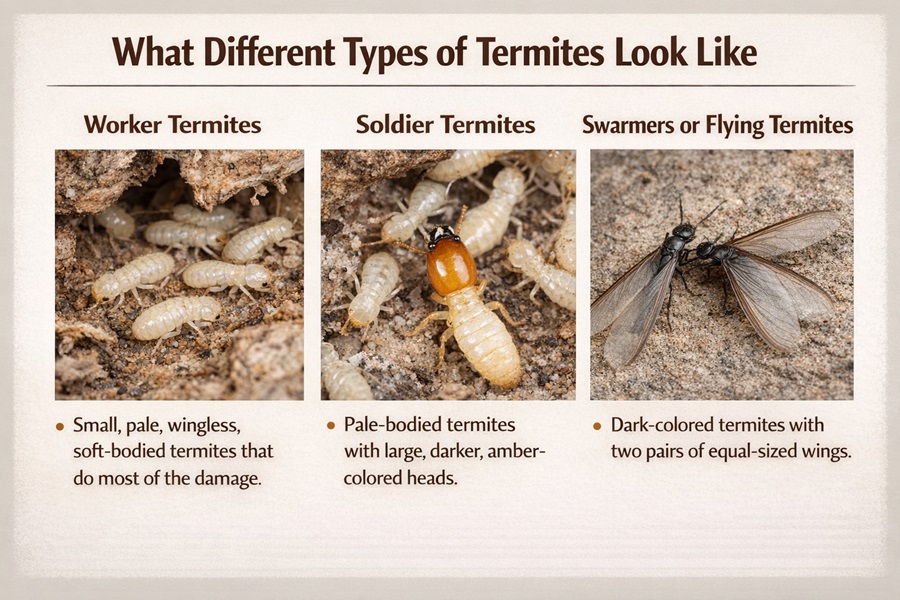
Worker termites
Worker termites are the ones doing all the damage, feeding an so on. Usually small pale and wingless, as well as soft bodied. Because they try to avoid light and stay inside wood, soil or shelter tubes, they’re not the first termites a homeowner tends to see.
Soldier termites
Soldier termites have the pale bodies of workers but their heads are larger and more noticeable. Depending on the type of termite, the head may be a bit darker or more amber than the rest of the body.
Swarmers or flying termites
Swarmers are the reproductive termites that are off to start new colonies. They’re usually darker than workers and the ones that homeowners notice most often. Their most obvious feature is their two pairs of wings which are equal in size and shape.
What do flying termites look like?
Flying termites usually have straight antennae, a broad waist, and four long wings of similar length. The wings often extend past the body and can look pale or translucent. This is one of the easiest ways to separate a termite swarmer from a flying ant, which has a pinched waist and larger front wings than rear wings.
They also tend to show up suddenly, often near doors, windows, or light sources. After swarming, they may leave behind piles of shed wings. Sometimes the insects themselves are gone by the time a homeowner notices something is wrong, but the wings remain.
Termites vs ants: how to tell the difference fast
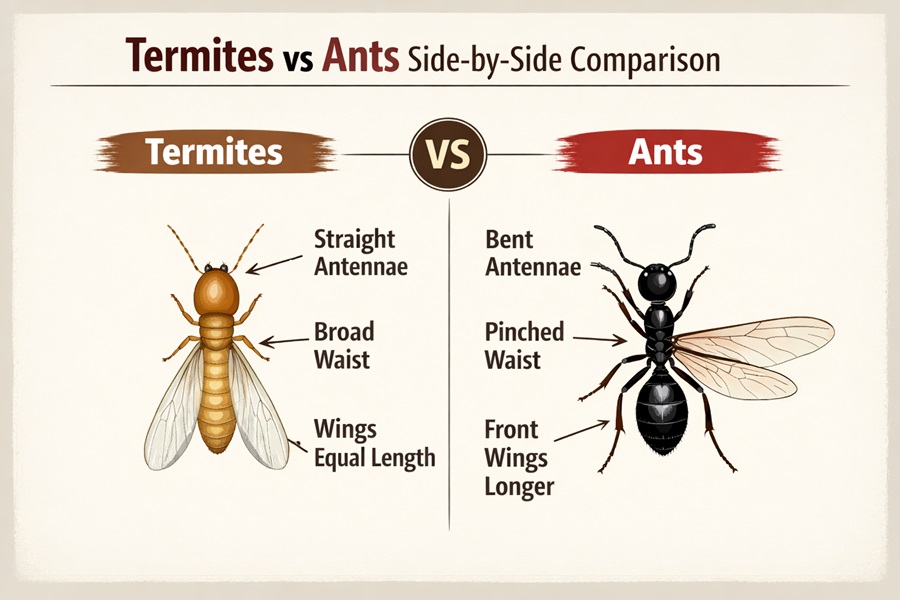
This is one of the most common identification problems, and it is also one of the most important. If you mistake termites for ants, you may ignore a structural pest issue that needs fast attention.
| Feature | Termites | Ants |
| Antennae | Straight | Bent or elbowed |
| Waist | Thick and broad | Narrow and pinched |
| Wings | Equal length | Front wings longer than back wings |
| Body shape | Straighter, softer-looking | More segmented and defined |
| Typical first clue | Wings, tubes, hidden wood activity | Open movement in visible areas |
These differences are consistently emphasized by extension and university entomology resources.
Places You Might Spot Termites in Your Home
People usually don’t see termites themselves before they notice some signs of termite activity. According to the EPA, termites are pretty shy and rarely are you going to catch them wandering out in the open from the soil, mud tubes, or wood they’re chewing through. That’s why most people only find out they have a problem when the damage gets bad.
Termite activity is often found in some pretty common places around the house:
- window sills and door frames where they can easily get in
- baseboards and trim which can be right on the soil line
- crawl spaces and basements where moisture is higher
- foundation walls where they can easily get in from the ground
- any exposed wood near the house, especially if it’s damp
- areas that get a lot of moisture like bathrooms or laundry rooms
Wood that’s in contact with the soil or is damp deserves extra attention from you. The USDA says that underground termites love to attack wood that’s right on the ground, and they’ll often build special tubes to get to the wood that’s above ground.
Catching Termites Early
Even when the termites are hiding, you might notice some pretty obvious warning signs.
Mud Tubes on Your Walls or Foundation
Mud tubes are one of the clearest signs of termites. These narrow little tunnels made of dirt help the termites get around without drying out or getting caught in the air. The EPA and USDA both point to mud tubes or shelter tubes as a pretty clear sign that you’ve got a termite problem.
Wings Everywhere
After a swarm, termites often lose their wings. So if you see a bunch of equal-sized wings near a window, door, or light source, that’s a pretty good clue that there was a swarm going on. The EPA says this is definitely a warning sign.
Wood that Sounds like a Tin Can
Termite damage often starts from the inside, so the wood can look fine on the surface but be completely rotten underneath. The USDA says that if you tap on some wood and it sounds hollow, that’s a good reason to get it checked out.
Paint Bubbles and Warped Surfaces
Bubbling paint, warped trim, or a warped wall surface can look like just a normal moisture problem. But when you notice it alongside some of the other signs, it’s worth taking a closer look because moisture and termite damage often go hand in hand. This is just an educated guess based on what the EPA and USDA say.
Tiny Trash Piles
Some termites leave behind tiny little droppings. While this is more common with drywood termites than with underground termites, if you see some small piles of debris near wood, you should take a closer look.
Doors and Windows that Suddenly Won’t Budge
If the wood in your house is changing shape from hidden damage or moisture, your doors and windows might start sticking. That’s not always a sign of termites by itself, but when you put it together with some of the other signs, it becomes more suspicious. This is just how I’ve seen termite damage play out in homes.
What Termite Damage Looks Like
At first, termite damage can be pretty sneaky. You might notice a baseboard that’s just a little uneven. Or a spot of paint that’s blistered up. Or you walk across the floor and a certain floorboard feels kinda soft underfoot. Over time, the wood can crack, crumble, or just start to break down altogether – especially if the termites have made their way inside and started tunneling through it.
According to Nevada Department of Agriculture – the folks who are experts on all this – the thing about termite damage is that it often isn’t visible from the outside because the worker termites hang out inside the wood they’re eating. That’s just one reason why you might not catch on to termite damage right away.
When Are Termites Most Active In the USA?
Now, I know what you’re thinking – when are termites most likely to be causing trouble? Well, the answer’s a little complicated. It really depends on the region you live in and what kind of termites are active in your area. but here’s the thing – a lot of people first notice termites when they’re swarming – and that usually happens in the spring or other really warm, humid times of the year. And if you talk to the universities and extension services that deal with this stuff, they all seem to agree – spring swarms are the most common time for folks to suddenly start seeing winged termites inside their homes or around their house.
But don’t get the idea that termites only cause problems in the spring. No way – colonies can stay active all year round, especially in warmer parts of the country.
Can You See Termites with Your Naked Eye?
Believe it or not, yes – you can see termites with your naked eye. Flying termites are the easiest to spot, but workers – the ones that are actually eating the wood – are way harder to notice because they like to stay hidden inside the wood, or in the soil, or in mud tubes. That’s just one reason why a lot of termites go undetected until a swarm or some damage makes it obvious.
What to Do If You Think You’ve Seen Termites
Don’t just assume they’re ants and move on. Take a closer look at the antennae, the waist, and the wings. If you can get a clear photo, do that too. And then check around to see if you can find any other signs of termites – like discarded wings, mud tubes, or suspicious-looking damage to the wood.
And please, don’t think that just because you killed a few visible insects, you’ve solved the problem. Remember – those flying termites might just be the tip of the iceberg. The EPA says it’s always a good idea to get a professional in to do a proper inspection and treatment if you suspect termites.
When to Call a Pest Control Professional
So, when do you know it’s time to call in a professional? Well, if you keep seeing swarmer activity, mud tubes, hollow wood, or unexplained damage to the wood, that’s a big red flag. And if you live in an area where termites are a big problem, or you’re buying or selling a house, or you keep finding the same warning signs in the same spot, get someone in to check it out. EPA guidance for homeowners is clear – if you suspect termites, it’s time to get a proper inspection and treatment plan.
How to Lower Your Chances Of Getting A Termite Problem
No one has ever developed a foolproof plan to keep termites away, but doing these things makes a house a whole lot less appealing to them:
- Deal with any water leaks and drainage issues before they become big problems
- Minimise the amount of wood your home touches the ground
- Keep all your clutter and unwanted wood stored well away from the house foundations
- Keep an eye on crawl spaces, basements and damp areas to see if anything looks suspicious
- Consider getting regular inspections if termite problems are a common issue in your area
The Bottom Line
What do termites actually look like? They are usually very small, soft bodied and have straight antennae, a noticeable waist and a coat that can range from a pale creamy colour to a darker brown depending on the type of termite. Worker termites are tiny and can be hard to spot. Soldiers have bigger heads and a more noticeable build. Flying termites are a lot easier to spot because they have the same length wings.
But for homeowners, the real issue isn’t so much what the creature looks like. Its more about what happens around it. You’ll start to notice mud tubes, shed wings, hollow wood, warped surfaces and damage that seems to come from nowhere. And those are the key signs that you need to be on the lookout for.
Catch those signs early and you’ve got a much better chance of dealing with termites before the problem spirals out of control and becomes a costly nightmare.
Frequently Asked Questions
What Colour Are Termites?
Most worker termites are pale white, sort of a cream or light tan. Soldier termites can look similar but they might have a darker head. Flying termites on the other hand are often darker brown or almost black.
Are Termites Visible To The Naked Eye?
Yes. Termites are definitely visible to the human eye. Swarmers are especially easy to spot. Workers can be harder to find because that’s what they’re good at – staying hidden in wood, soil or under shelter.
What Do Baby Termites Look Like?
Baby termites are tiny, pale and soft bodied and basically look like workers. They are usually found hiding inside the colony, sheltered from view.
Do Termites Look Different From Carpenter Ants?
Yes. Termites have straight antennae, a broad waist and wings that are the same length. Carpenter ants, by the way, have bit elbowed antennae, a slim waist and front wings that are longer than the back ones.
What Do Termite Wings Look Like?
Termite wings are long and delicate, pale or semi see-through and exactly the same length. You often find them scattered around windows, doors and other areas with a lot of light after the swarming is done.
Can One Flying Termite Mean I Have A Big Termite Problem?
One flying termite on its own usually doesn’t mean that your house is infested with termites. But if you start seeing more of them, shed wings, mud tubes or wood damage nearby, now would be a great time to get a professional in for a look see. This is just good sense and follows the EPA advice of treating termite signs with caution rather than brushing them off.
