

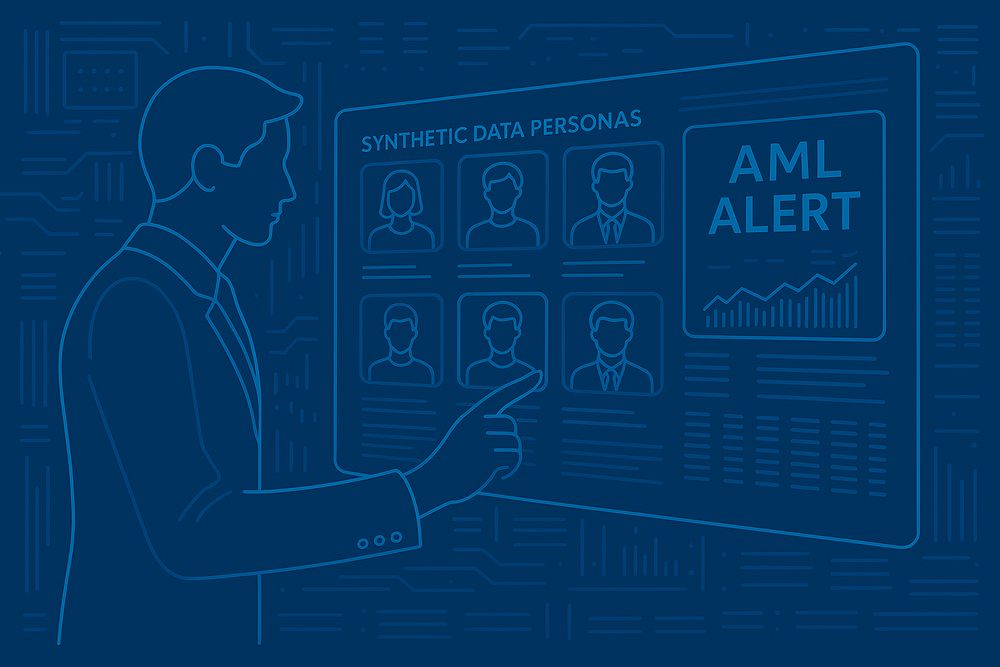
Despite billions spent on financial crime compliance, anti-money laundering (AML) systems continue to suffer from structural limitations. False positives overwhelm compliance teams, often exceeding 90-95% of alerts. Investigations remain slow, and traditional rule-based models struggle to keep up with evolving laundering tactics.
For years, the solution has been to layer on more rules or deploy AI across fragmented systems. But a quieter, more foundational innovation is emerging-one that doesn’t start with real customer data, but with synthetic data.
If AML innovation is to truly scale responsibly, it needs something long overlooked: a safe, flexible, privacy-preserving sandbox where compliance teams can test, train, and iterate. Synthetic data provides exactly that-and its role in removing key barriers to innovation has been emphasized by institutions like the Alan Turing Institute.
The Limits of Real-World Data
Using actual customer data in compliance testing environments comes with obvious risks, privacy violations, regulatory scrutiny, audit red flags, and restricted access due to GDPR or internal policies. As a result:
- AML teams struggle to safely simulate complex typologies or behaviour chains.
- New detection models stay theoretical rather than being field-tested.
- Risk scoring models often rely on static, backward-looking data.
That’s why regulators are beginning to endorse alternatives. The UK Financial Conduct Authority (FCA) has specifically recognized the potential of synthetic data to support AML and fraud testing, while maintaining high standards of data protection3.
Meanwhile, academic research is pushing the frontier. A recent paper published introduced a methodology for generating realistic financial transactions using synthetic agents, allowing models to be trained without exposing sensitive data. This supports a broader shift toward typology-aware simulation environments
How It Works in AML Contexts
AML teams can generate networks of AI created personas with layered transactions, cross-border flows, structuring behaviours, and politically exposed brackets. These personas can:
- Stress-test rules against edge cases
- Train ML models with full labels
- Demonstrate control effectiveness to regulators
- Explore typologies in live-like environments
For instance, smurfing, breaking large sums into smaller deposits. This can be simulated realistically using frameworks like GARGAML, which tests smurf detection in large synthetic graph networks. Platforms like those in the Realistic Synthetic Financial Transactions for AML Models project allow institutions to benchmark different ML architectures on fully synthetic datasets.
A Win for Privacy & Innovation
Synthetic data helps resolve the tension between enhancing detection and maintaining customer trust. You can experiment and refine without risking exposure. It also helps rethink legacy systems, imagine reworking watchlist screening through synthetic-input-driven workflows, rather than manual tuning.
This approach aligns with emerging guidance on transforming screening pipelines using simulated data to improve efficiency and reduce false positives
Watchlist Screening at Scale
Watchlist screening remains a compliance cornerstone-but its effectiveness depends heavily on data quality and process design. According to industry research, inconsistent or incomplete watchlist data is a key cause of false positives. By augmenting real watchlist entries with synthetic test cases-named slightly off-list or formatted differently-compliance teams can better calibrate matching logic and prioritize alerts.
In other words, you don’t just add rules-you engineer a screening engine that learns and adapts.
What Matters Now
Regulators are fast tightening requirements-not just to comply, but to explain. From the EU’s AMLA to evolving U.S. Treasury guidance, institutions must show both effectiveness and transparency. Synthetic data supports both: systems are testable, verifiable, and privacy-safe.
Conclusion: Build Fast, Fail Safely
The future of AML lies in synthetic sandboxes, where prototypes live before production. These environments enable dynamic testing of emerging threats, without compromising compliance or consumer trust.
Recent industry insights into smurfing typologies reflect this shift, alongside growing academic momentum for fully synthetic AML testing environments.
Further Reading:
GARGAML: Graph based Smurf Detection With Synthetic Data
Realistic Synthetic Financial Transactions for AML
What Is Smurfing in Money Laundering?
The Importance of Data Quality in Watchlist Screening
The post Why Synthetic Data Is the Key to Scalable, Privacy-Safe AML Innovation appeared first on Datafloq.
