


[ad_1]
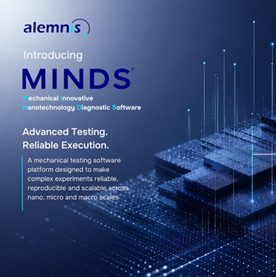
Alemnis AG is proud to introduce MINDS (Mechanical Innovative Nanotechnology Diagnostic Software), a new software platform designed to help laboratories automate complex mechanical testing workflows and improve reproducibility.
As mechanical testing becomes increasingly sophisticated, from in-situ experiments and coupled environmental testing to micropillars, thin films, MEMS, and biomaterials laboratories face growing pressure to execute experiments consistently across multiple users, instruments, and long-term research programs.
In many laboratories, advanced experiments still rely heavily on manual configuration, operator expertise, fragmented procedures, and separate post- processing tools. As a result, subtle differences in how workflows are executed can introduce variability and make results more difficult to compare over time.
MINDS was developed to address this challenge directly.
MINDS does not change what you test – it changes how reliably and efficiently you can execute it.
Turning Complex Workflows into Automated Processes
The core innovation of MINDS is automation.
The platform enables users to transform complex testing procedures into structured, automated workflows that can be executed consistently with minimal manual intervention. Once a workflow is defined, MINDS performs the required experimental and analysis steps automatically, ensuring that each test is executed in the same way regardless of who runs it.
By reducing dependence on operator experience and manual setup, MINDS helps laboratories:
- Standardize advanced testing procedures
- Minimize user-to-user variability
- Reduce human error
- Increase throughput
- Integrate data analysis directly into the workflow
- Scale testing activities more efficiently
This automation-driven approach allows laboratories to focus less on repetitive operational tasks and more on interpreting high-quality, reproducible data.
Unified Platform for Mechanical Testing and Analysis
MINDS serves as Alemnis’ next-generation software platform for experiment control and data analysis, replacing legacy software environments including AMICS-ECO and AMMDA while maintaining compatibility with existing Alemnis data.
The platform supports a wide range of experiments, including indentation, compression, tension, mapping, and scratch testing, with full control of positioning, load, and displacement.
Integrated analysis capabilities allow users to evaluate hardness, elastic modulus, stress–strain behavior, creep, and other key mechanical properties within the same software environment.
Designed for Modern Research Laboratories
MINDS was developed in close collaboration with researchers working across diverse application areas, including:
- Materials science
- Semiconductor devices
- Nuclear materials
- Coatings and surface engineering
- MEMS and microstructures
- Biomaterials and biomechanics
- Advanced manufacturing
Whether testing irradiated materials under controlled environments, soft biological tissues, or complex microfabricated devices, MINDS provides a robust framework for executing experiments with greater consistency and confidence.
Flexible and Scalable Architecture
Built on a modular software architecture, MINDS can be expanded through plug-ins that support additional hardware modules and new functionalities as laboratory requirements evolve.
This design allows users to upgrade and extend their systems while protecting existing workflows and long-term investments.
A New Standard for Reliable Mechanical Testing
With MINDS, Alemnis introduces a software platform that addresses one of the most significant challenges in advanced mechanical testing: executing increasingly complex experiments in a reliable, reproducible, and scalable way.
From nanoindentation to macro-scale characterization, MINDS enables laboratories to automate sophisticated workflows and generate consistent, high-quality results across users, instruments, and time.
[ad_2]
Source link
