


[ad_1]
Engineers and clinicians have found that adding light-absorbing nanoparticles to surgical saline can make laser kidney stone removal up to seven times more efficient, without raising heat risks or harming healthy tissue.
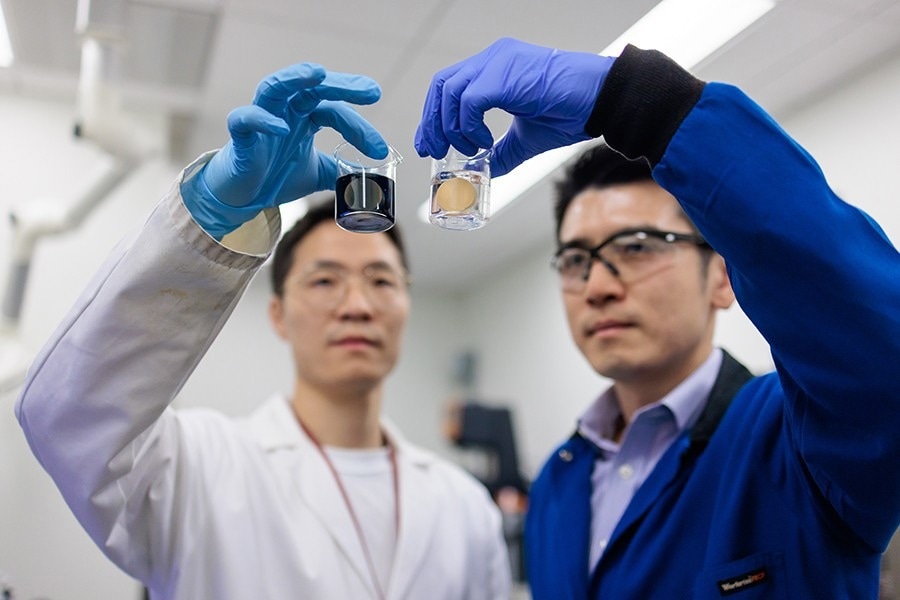
Researchers from the University of Chicago and Duke University developed a nanoparticle-infused saline solution that improves the efficiency and safety of laser lithotripsy for kidney stones.
The study, published in Advanced Science, demonstrates that conducting polymer nanofluids can boost laser performance up to sevenfold without increasing tissue damage.
Laser lithotripsy is a process where urologists use a small, video-assisted laser to fragment painful and potentially harmful kidney stones into tiny pieces.
To make the method as seamless as possible, kidney stones need to be disintegrated into the finest possible particles, ideally to dust, so that they can be safely removed through suction.
However, using more powerful lasers generates extra heat that may harm adjacent tissue and cause discomfort to the patient.
Obviously, you don’t want to over-pump the energy into your kidney, because that’s very dangerous. What we demonstrate in our work is a way to better use the laser energy that is already being used.
Po-Chun Hsu, Assistant. Professor, Pritzker School of Molecular Engineering, University of Chicago
The implications of this research could lead to reduced surgery durations, quicker recovery times, and a lower rate of recurrence for a condition that impacts 11 % of the American population.
A Solution in Solution
The interdisciplinary team developed the solution while exploring methods to enhance performance without modifying the laser itself.
Their solution was a novel dispersion of polymer nanoparticles in saline.
Saline, a clinical, slightly salty water, is used by doctors to expand the hollow section of the kidney and ensure visibility throughout the lithotripsy. Typically, a significant portion of the laser energy is lost in the saline as heat during the procedure.
However, the researchers discovered that incorporating dark nanoparticles that absorb specific laser wavelengths into this saline solution allows the laser to remain focused on the stone, instead of reflecting or dissipating energy.
This advancement multiplies the amount of laser energy transmitted to and absorbed by kidney stones, improving disintegration substantially.
Each laser has its own inherent wavelength based on the technology by which the laser was generated. People thought, ‘If the wavelength is fixed, you cannot change the absorption of the laser in the working fluid or in the stone that you’re trying to target. Nanofluid brings a new dimension, independent of the stone composition, independent of the laser, that can affect this very complex physical procedure.
Pei Zhong, Study Corresponding Author and Professor, Duke University.
However, according to Qingsong Fan, a postdoctoral researcher at UChicago PME, not all nanofluids are suitable for medical procedures.
First of all, the solution should be absorptive at the wavelengths of the laser, which is around 2,000 nm or two µm. The second criterion is that the nanoparticles should disperse well in water because that’s how we irrigate the kidney. And the third, and the most important criterion, is that it should be safe.
Qingsong Fan, Study Author, Postdoctoral Researcher at UChicago PME
Tests conducted on lab-grown kidney stones indicated that the team successfully achieved all three objectives. The nanofluid enhanced stone ablation efficiency by 38 to 727 % during spot treatment and by 26 to 75 % in scanning treatment.
Exposing living cells to the nanofluid for varying durations, up to 24 hours, showed that the effective nanoparticle solution was also non-toxic and safe.
In practical applications, however, this material will not be in contact with cells for nearly that duration. Lithotripsy is an outpatient procedure that typically lasts around 30 minutes. Hsu is optimistic that enhancing the absorption efficiency could reduce that time to 10 minutes.
“If you spend too much time in this surgery, then waste heat from the laser will accumulate, and that’s actually going to be more harmful than the ablation itself,” said Hsu.
Different Stones, Different Lasers
The research concentrated on holmium:yttrium-aluminum-garnet (Ho-YAG) lasers and artificially cultivated kidney stones. Ho-YAG, recognized as the gold standard for laser lithotripsy, is the most prevalent type of laser employed, although it is not the sole option available.
Some lasers perform well in dusting, other lasers perform better in fragmenting, but no laser can perform exceptionally well both in dusting and fragmenting. Unless you are at a major hospital like the University of Chicago or Duke, community doctors may not be able to afford multiple lasers. Nanofluid has the potential to enhance the performance of each laser under different clinical scenarios.
Pei Zhong, Study Corresponding Author and Professor, Duke University.
Next steps will involve conducting tests to evaluate the effectiveness of the new technique with various standard lithotripsy lasers and assessing its effects on actual kidney stones, as opposed to those cultivated in a laboratory setting.
Journal Reference:
Fan, Q., et al. (2025) Nanofluid-Enhanced Laser Lithotripsy Using Conducting Polymer Nanoparticles. Advanced Science. doi.org/10.1002/advs.202507714
Source:
[ad_2]
Source link
