


[ad_1]
This blog is part of our focus on Cisco employees who are “Striving for Sustainability” by finding opportunities to integrate sustainability in their day-to-day work.

Over the past several years, we have built an engine to achieve our goal to incorporate Circular Design Principles into 100% of our new products and packaging by fiscal 2025.
One of the key drivers behind this effort is Ajay Ranjith Vempati, Circular Design Lead at Cisco. Ajay’s first lessons in circularity came while growing up on his parent’s farm in India, where nothing went to waste; crop residues became animal fodder, manure enriched the soil, and food scraps returned to fields. His mother carried the same spirit into daily life: worn-out clothes lived many lives as comforters, dusting rags, or doormats while milk pouches, newspapers, and books were carefully stored for recyclers.
These experiences shaped his belief that nothing is ever a waste — only a resource in transition. Today, he brings those learnings into his work, embedding circularity into Cisco’s product design. Learn more about Ajay’s journey at Cisco:
How did Cisco’s circular design journey begin and what inspired it?
Ajay: Cisco engineers have been embedding sustainability into products and packaging for over a decade. The Circular Design program picked up momentum a few years before I joined. During that time, Cisco announced some ambitious circular design goals, the teams conducted product teardowns to understand the biggest opportunity areas, and a group of internal champions helped to create Cisco’s Circular Design Principles and a gamified training program.
When I joined Cisco in 2021, my role was to act as a catalyst: bring people together, simplify and scale the approach, and give engineers tools to make it their own. We developed a design scoring mechanism and embedded it into the tools that Cisco engineers use every day. Then we trained over 7,000 engineers. This would not have been possible without the amazing partnerships we have with leaders and team members across Cisco’s hardware engineering and supply chain teams.
What were some challenges faced during this journey, and how were they overcome?
Ajay: One of our biggest challenges was figuring out how to scale this process across a company with such diverse products. With hundreds of products released each year, it quickly became clear that evaluating each product and packaging design manually just wasn’t feasible. That’s when we started to develop IT tools that would embed the circular design evaluation directly into our design process. By integrating these requirements into tools our engineering and supply chain teams already use, teams could more easily adopt circularity without stepping outside their normal workflow.
Leadership was incredibly supportive; they are now accountable for circular design just like they are accountable for cost and quality metrics, and new designs cannot be released to production until they meet circular design criteria.
Alongside the technical solution, we also focused on socialization — making sure everyone understood what was changing and why. We participated in all-hands and team meetings and relied on champions within each business unit to drive adoption. Ultimately, it was this combination of robust tools, leadership support, and engagement that helped us to scale the program successfully.
I understand the engineering teams have embraced circular design. Can you share an example of a novel innovation they developed?
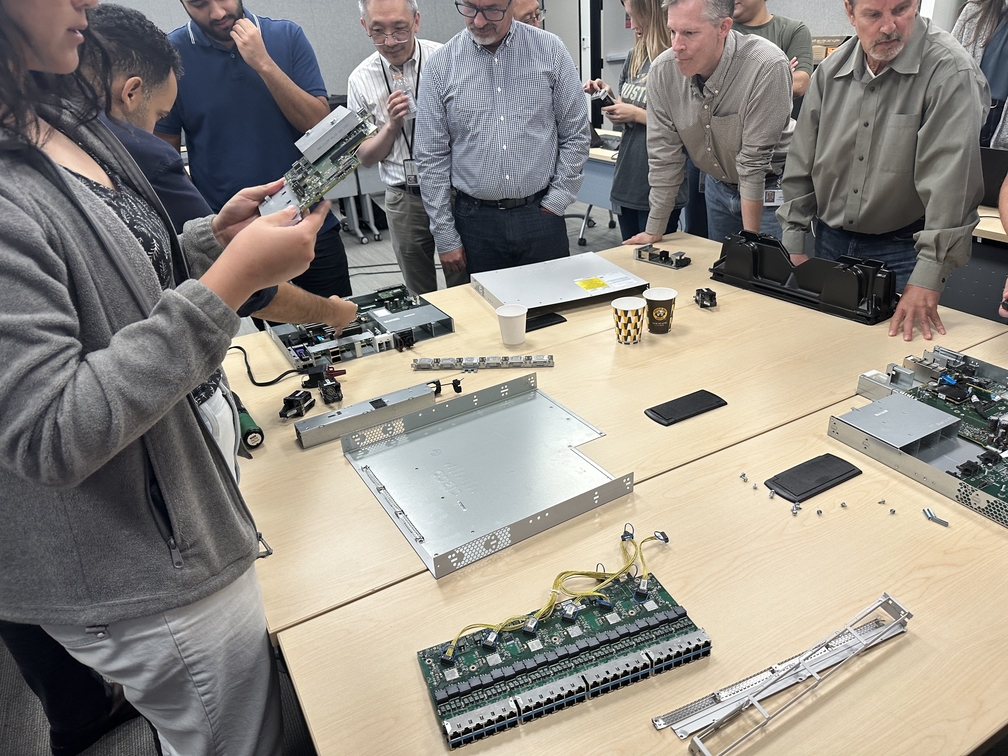
Ajay: Yes – one example traces back to a product teardown we hosted. While disassembling a switch, the team realized that the functionality of the steel enclosure could be maintained even with reduced thickness. This led Cisco to redesign the enclosure of the C9350 smart switch, resulting in material savings and improved efficiency without compromising performance. By using less steel, we reduce sourcing and shipping costs, while also avoiding the associated greenhouse gas (GHG) emissions from the production and transportation of that material.
To me, this is a great example of innovation and cross-team collaboration. The engineers went beyond their usual scope, engaged with marketing and customers, and got everyone on board using something a little different — without impacting the customer experience. It really challenged the mindset of “this is how we’ve always done it.”
We’re experiencing similar shifts in packaging. Foam used to be the standard way to protect our products, but now we’re seeing packaging designs that eliminate foam and plastic. People are pushing past conventional thinking about what’s possible from a design perspective. It’s not easy — there are lots of stakeholders to engage — but teams are breaking out of their silos to make changes, and that’s been truly impactful.
How do you see Cisco’s circular design efforts benefiting customers and the broader industry?
Ajay: We know that customers are increasingly looking for products that have lower environmental footprints and reduced energy and maintenance costs. Many of our customers — especially in Europe and among Fortune 500 companies — have their own sustainability goals, and they’re seeking products that help them meet those standards.
Our approach to circular design directly supports those needs. For our customers, it means products that use fewer resources, last longer, cost less to operate, are easy to repair or upgrade, and can be recycled effectively.
On a broader industry level, what’s unique about our approach is how it’s deeply embedded in the way we design our products and packaging. This isn’t just a pilot or a niche initiative. Circular design is now built into the development of every new product and packaging at Cisco. We’ve created a model that shows how design itself can be a catalyst for delivering on sustainability and business goals at scale — not just for us, but for the entire industry.
What’s next for circular design?
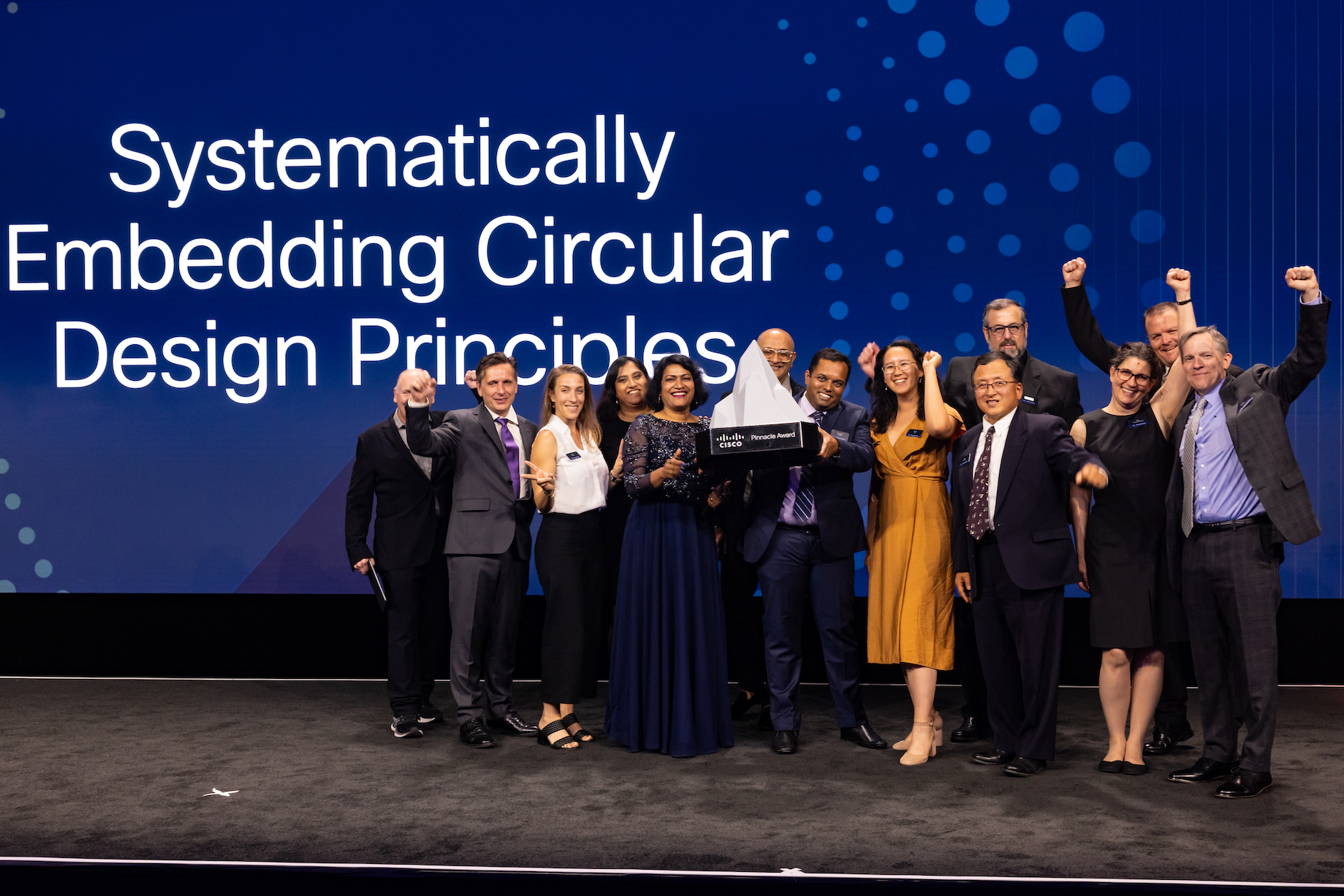
Ajay: We’re actively expanding and revising our criteria by listening to our stakeholders, including our customers, employees, regulators, and investors. We’re updating our Circular Design Principles to make sure we’re ready for the future. We aim to move the needle on topics like using recycled metals, removing hazardous materials, and making our evaluation criteria more product-specific — because Cisco’s product diversity means there’s no one-size-fits-all approach.
We’re also raising the bar for our engineering and design teams. Our initial training was a great foundation, but now we’re developing advanced, role-specific training with real-life examples and practical tools that engineers can use in their day-to-day work to incorporate circularity. It’s about moving beyond just telling teams to use recycled materials.We’re showing them how, and what to consider in the process.
I’m genuinely excited about where we’re headed. The next phase will be rigorous and require significant effort, but it will also be rewarding. Circular design isn’t just about doing good for the environment. By using recycled materials and designing products that last longer and are easier to repair and recycle, we’re preparing to be more future-ready and resilient from a supply chain perspective, while meeting the evolving expectations of stakeholders. In many ways, this is becoming a true business imperative, not just a sustainability goal.
[ad_2]
Source link
