


A team of researchers from Poland have developed new mathematical methods that could help enable better control of quantum entanglement and teleportation experiments

Most headline-grabbing advances in quantum mechanics today are experimental in nature: more qubits, entangled particles, fewer errors.
Often overlooked are the advances in the mathematics that underpins the behaviour of these quantum systems.
The walled Brauer algebra is an abstract but increasingly important mathematical structure that appears in quantum information theory whenever physicists study particles, symmetries and transformations involving permutations and partial transposition.
Work in this area inevitably leads to the question of how a system transforms when particles are permuted or when one part of a composite object is flipped (transposed) while the rest is left untouched. Collect all such operations together and you get the walled Brauer algebra. It plays an important role in the mathematical description of problems ranging from entanglement detection to advanced teleportation schemes.
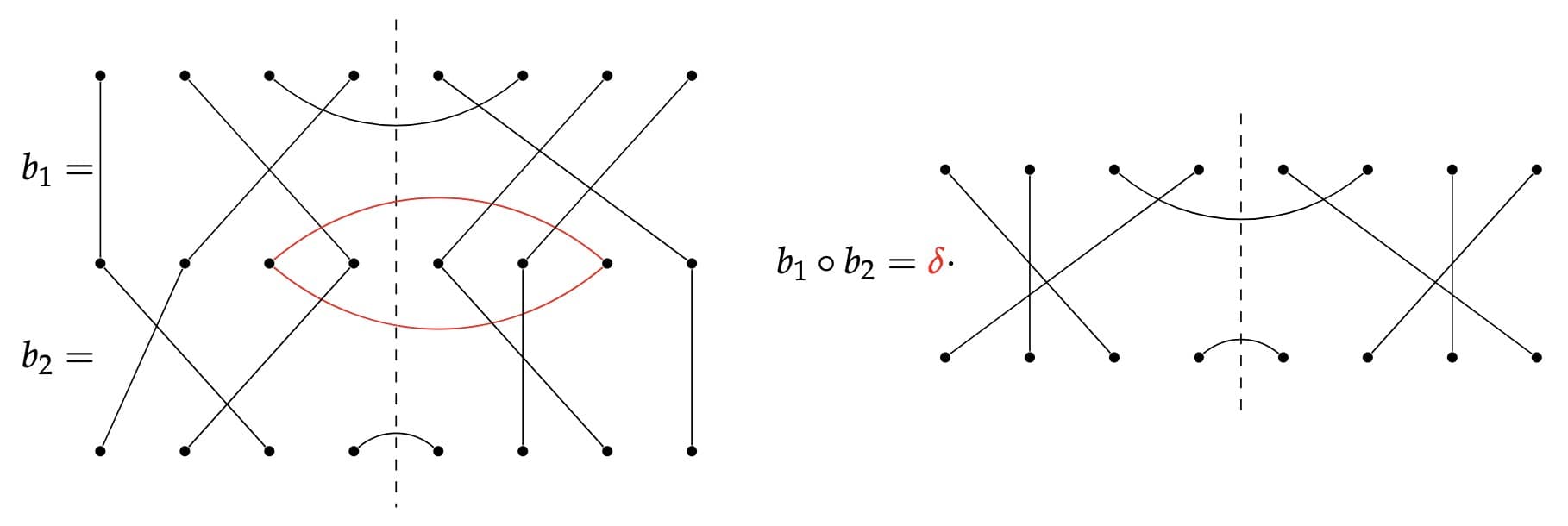
The problem is that this algebra is famously intricate. Until now, physicists have only been able to describe its structure using methods that do not fully align with the natural symmetries of the system, making calculations heavy and sometimes opaque.
The new work changes that. The authors have developed an iterative construction that builds the algebra piece by piece, revealing its architecture in a symmetry-compatible way. Instead of a tangled hierarchy, the algebra unfolds into independent components, each shaped by the action of two symmetric groups.
The result is not just a more elegant mathematical picture; it is also a new framework that can make symmetry-based analysis of complex quantum-information problems more systematic and transparent.
This matters now more than ever. Quantum technologies increasingly involve many-particle configurations where symmetry is both a feature and a challenge. Teleportation schemes that move quantum information without moving particles, algorithms that manipulate unknown quantum operations, and proposals for higher-order quantum processes all rely on understanding how transformations behave under symmetry.
By clarifying this structure, the new framework could help researchers analyse these settings more effectively and support the development of better-controlled entanglement- and teleportation-based protocols.
