


[ad_1]
Orbeez are small water beads made from superabsorbent polymer material. Drop them in water and they expand into soft, squishy balls. They are popular for sensory play, crafts, décor, and toy blasters, but they can be dangerous if swallowed and should never be flushed, composted, or left where young children or pets can reach them.
Key Takeaways
- Orbeez are a branded type of water bead made from superabsorbent polymer material.
- They expand because their internal polymer structure pulls in and traps large amounts of water.
- They are usually safe to touch, but they are dangerous if swallowed, inhaled, or inserted into the nose or ears.
- New U.S. safety rules for water bead toys took effect in 2026, adding stricter limits on expansion size, acrylamide content, and warning labels.
- Standard Orbeez-style beads are not compostable, drain-safe, or meaningfully biodegradable for everyday household use.
What Are Orbeez?
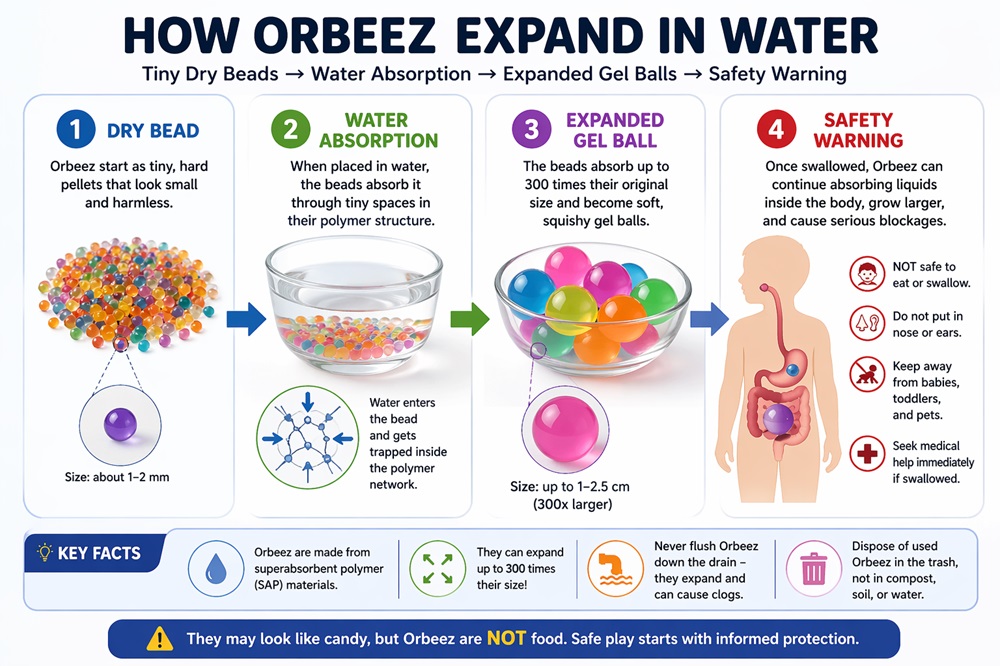
Orbeez are tiny, colorful beads that grow when placed in water. In their dry form, they look like small pellets, often about the size of a sprinkle. After soaking for several hours, they expand into soft gel-like balls.
It is a branded type of superabsorbent polymer bead. The product was introduced in 2010 by Maya Group and is now owned by Spin Master. In dry form, the beads are tiny, hard pellets. Add water, and they swell into soft, clear gel balls that can hold many times their own weight in liquid.
The main material is usually linked to sodium polyacrylate, a synthetic polymer made from acrylic acid and sodium-based compounds. Acrylic acid is commonly produced from propylene, a petroleum-derived chemical. That matters because Orbeez are not natural beads, even though they look simple and toy-like after soaking.
Their water-holding power comes from their structure. Sodium polyacrylate has a cross-linked network of polymer chains. When the beads sit in water, the material pulls water inward and traps it inside. The cross-links stop the beads from dissolving, so they swell while keeping their round shape.
They became popular as children’s toys, sensory bin fillers, vase décor, craft supplies, and party decorations. In recent years, they also showed up in toy blasters and social media trend videos.
Common names include:
| Term | What It Means |
| Orbeez | A branded product |
| Water beads | The broader product category |
| Gel beads | Common alternative label |
| Jelly beads | Another common name |
| Sensory beads | Often used in parenting and classroom markets |
They look harmless. That is part of the problem. Dry beads resemble candy, and hydrated beads feel like toys meant for younger children. In practice, that misunderstanding has led to serious injuries.
What Are Orbeez Made Of?
Orbeez are made from superabsorbent polymer (SAP) material, often linked to sodium polyacrylate or similar acrylate-based compounds.
These polymers are built to absorb large amounts of liquid while staying intact.
The same material family is used in products like:
- Disposable diapers
- Hygiene products
- Agricultural water-retention materials
- Medical absorbents
- Moisture-control packaging products
For Orbeez, manufacturers turn the polymer into tiny dry pellets. Once water enters the bead, the material swells and forms a soft gel texture.
That sounds simple, but the chemistry is doing a lot of work.
What Is a Superabsorbent Polymer?
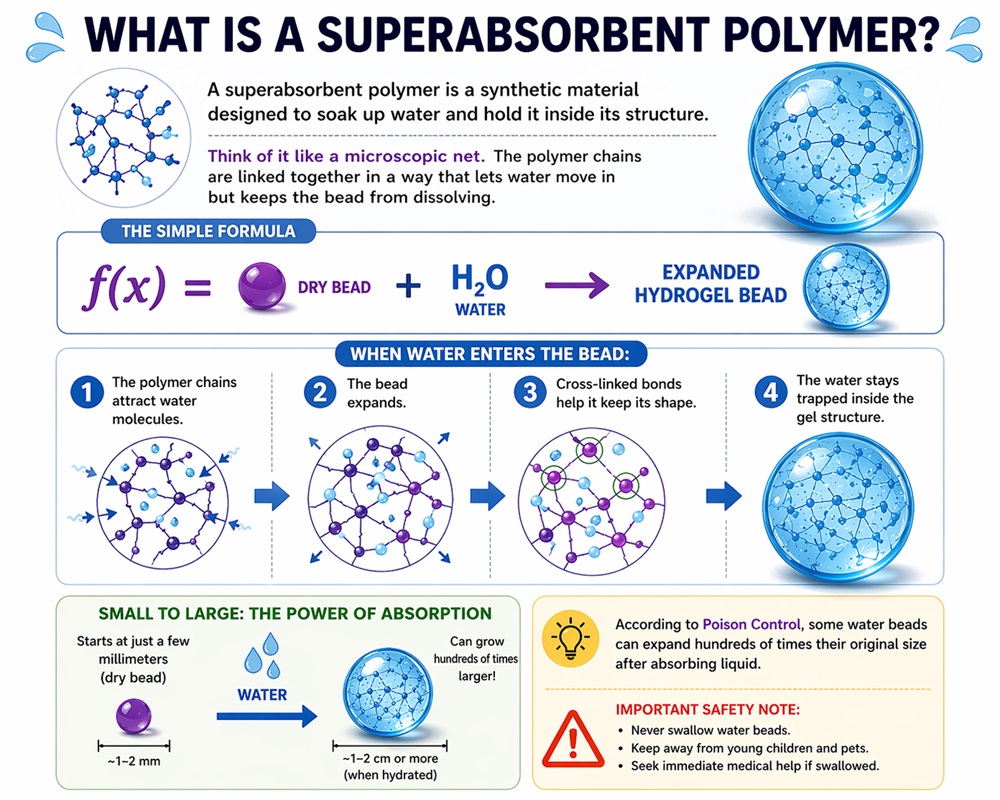
A superabsorbent polymer is a synthetic material designed to soak up water and hold it inside its structure.
Think of it like a microscopic net. The polymer chains are linked together in a way that lets water move in but keeps the bead from dissolving.
f(x)=dry bead+H2O→expanded hydrogel beadf(x)=\text{dry bead} + H_2O \rightarrow \text{expanded hydrogel bead}f(x)=dry bead+H2O→expanded hydrogel bead
When water enters the bead:
- The polymer chains attract water molecules
- The bead expands
- Cross-linked bonds help it keep its shape
- The water stays trapped inside the gel structure
That is why a bead that starts at a few millimeters wide can grow much larger after soaking.
According to Poison Control, some water beads can expand hundreds of times their original size after absorbing liquid.
Why Do Orbeez Expand in Water?
The expansion happens because of osmosis and polymer chemistry.
The dry bead contains tightly packed polymer chains. Once it touches water, liquid moves inside and fills the gaps in that structure.
The bead swells but does not fall apart because the polymer network holds everything together.
This is why:
- Dry beads are tiny
- Hydrated beads become marble-sized
- They stay soft and flexible instead of dissolving
Warm water often speeds up expansion, while saltwater can slow it down.
Are Orbeez Plastic?
Not in the way most people think about plastic beads.
They are not hard plastic like toy marbles or craft beads, but they are still made from synthetic polymer material.
That distinction matters because many people assume they behave like natural materials once they dry out.
They do not.
They should not be:
- Flushed
- Composted
- Mixed into garden soil
- Put in recycling bins
Even after shrinking, they remain synthetic material.
How Are Orbeez Used?
People use Orbeez for more than kids’ toys.
Common uses include:
- Sensory play
- Classroom activities
- Craft projects
- Vase fillers
- Party decorations
- Toy blasters
- Stress toys
- Photography props
Their popularity comes from their bright colors and unusual texture. They feel satisfying to touch, which explains why sensory content featuring water beads performs so well online.
That popularity has also led to misuse, especially among very young children.
Are Orbeez Safe for Kids?
For older children using them under adult supervision, the risk is lower.
For babies and toddlers, they are unsafe.
American Academy of Pediatrics has warned that water beads can expand inside the body after being swallowed. They can cause intestinal blockages and often do not appear clearly on X-rays.
They can also become lodged in:
- The throat
- The nose
- The ears
That creates medical emergencies fast.
Parent Safety Checklist
- Keep them away from children under 3
- Store unused beads in sealed containers
- Clean up spills immediately
- Check rugs, toy bins, and furniture after playtime
- Never let children place them in their mouth
- Call Poison Control immediately if one is swallowed
A bead on the floor is easy to miss. That is often how accidents happen.
U.S. Water Bead Safety Rules
In 2026, the U.S. Consumer Product Safety Commission introduced stronger federal safety standards for water bead toys.
The updated rules include:
- Maximum expansion limits
- Acrylamide restrictions
- Stronger warning labels
- New product testing requirements
This matters because older products and imported décor beads may not follow the same standards.
Parents should not assume every product sold online meets current safety rules.
Are Orbeez Toxic?
This is where many headlines get sloppy.
Orbeez are generally considered non-toxic to touch.
That does not mean they are safe to eat.
Poison Control says the larger concern is internal blockage after swallowing. Some products have also raised concerns about acrylamide exposure, which helped push newer federal regulations.
Touching them during supervised play is very different from swallowing them.
Related: Are Mylar Bags Toxic
What Happens If a Child Swallows Orbeez?
Treat it as urgent.
Do not wait for symptoms.
Contact Poison Control or seek emergency medical care right away.
Doctors often need to know:
- The product brand
- The bead size
- How many were swallowed
- When it happened
Water beads are difficult to detect in imaging scans, which makes fast action more important.
Are Orbeez Dangerous for Pets?
Yes.
Dogs often eat them from floors, trash bins, or backyards. Cats may treat them like toys.
Once swallowed, the same expansion risk applies.
American Society for the Prevention of Cruelty to Animals recommends contacting a veterinarian immediately if a pet consumes non-food items that may cause blockages.
Keep both dry and hydrated beads away from pets.
So, Are Orbeez Biodegradable?
Technically, yes. In practice, no, not in any time frame that makes sense for the environment.
Orbeez are usually made from sodium polyacrylate, a synthetic superabsorbent polymer. That material can break down under the right conditions, such as warmth, moisture, sunlight, and certain microbial activity. But “can break down” is not the same as breaking down quickly or safely in soil, water, or a landfill.
Research on sodium acrylate shows how slow that process can be. One study in Environmental Science and Pollution Research International estimated a decay rate of only 0.12% to 0.24% every six months. At that pace, a bead could take about 208 to 416 years to lose half its material. Full breakdown can stretch much closer to 1,000 years.
Landfills slow the process even more. They are often dry, compacted, and low in oxygen, which gives microbes little chance to work. In soil or waterways, the problem is different. Sodium polyacrylate does not offer useful nutrition for bacteria or fungi, so microorganisms do not break it down the way they break down leaves, food scraps, or paper.
That is why “biodegradable” can mislead consumers. The word only means a material can eventually break down. It does not tell you how long it takes, what conditions it needs, or whether the leftover pieces are harmless. For everyday use, Orbeez should not be treated as compostable, soil-safe, flushable, or environmentally friendly. Over time, they can remain in the environment and break into smaller plastic-like fragments.
Why the Biodegradable Claim Confuses People
Many consumers hear “biodegradable” and assume a product safely disappears in nature.
That is not what happens here.
The better question is:
Can you safely throw them outside, compost them, flush them, or mix them into soil?
For standard water beads, the answer is no.
Environmental Concerns With Orbeez
| Concern | Why It Matters |
| Slow breakdown | Synthetic polymers can persist for long periods |
| Drain clogs | They expand in water |
| Wildlife risks | Animals can mistake them for food |
| Recycling issues | Most curbside systems do not accept them |
| Microplastic concerns | Broken fragments can remain in the environment |
| Petroleum inputs | Many are made from fossil-derived materials |
The biggest issue is often cleanup. Loose beads spread fast and are easy to miss.
Can You Compost, Flush, or Put Orbeez in Soil?
No.
Do not:
- Flush them down toilets
- Wash them into sinks
- Put them in compost piles
- Scatter them outdoors
- Mix them into potting soil
They are designed to absorb water. Plumbing systems are exactly where you do not want that material.
How Should You Dispose of Orbeez?
The safest method is simple.
- Collect all beads
- Let hydrated beads dry if possible
- Place them in a sealed bag
- Throw them in regular household trash
- Check floors and drains for leftovers
This reduces the chance of them entering waterways or creating hazards for children and pets.
Can Orbeez Be Reused?
Yes, sometimes.
If they are clean, you can let them dry and rehydrate them later.
That reduces waste, but it does not solve the safety issue. If young children or pets live in the home, reuse may not be worth the risk.
Safer Alternatives to Orbeez
For sensory play, safer materials often work just as well.
Options include:
- Cooked pasta
- Chia seed gel
- Tapioca pearls
- Basil seeds
- Agar gel
- Large pom-poms for older children
- Water play bins with cups and sponges
For toddlers, edible sensory materials are usually the safer option.
The Bottom Line
Orbeez are small polymer beads built to absorb water and expand dramatically. The science behind them is interesting. The safety concerns are far more important.
They are not food. They are not compost. They are not drain-safe. And they do not belong around babies, toddlers, or pets.
For older kids using them under supervision, the risk drops. Still, many families now prefer safer sensory materials that do not come with the same cleanup headaches or medical risks.
FAQ
Are Orbeez the same as water beads?
Orbeez are a brand. Water beads is the broader category.
Why do Orbeez grow in water?
Their polymer structure absorbs and traps water.
Are Orbeez poisonous?
They are usually not toxic to touch, but swallowing them can be dangerous.
Can dogs eat Orbeez?
No. They can cause intestinal blockages.
Can you compost Orbeez?
No.
Can you flush Orbeez?
No.
Are Orbeez reusable?
Sometimes, if they are clean and stored properly.
[ad_2]
Source link
